Arco di Augusto
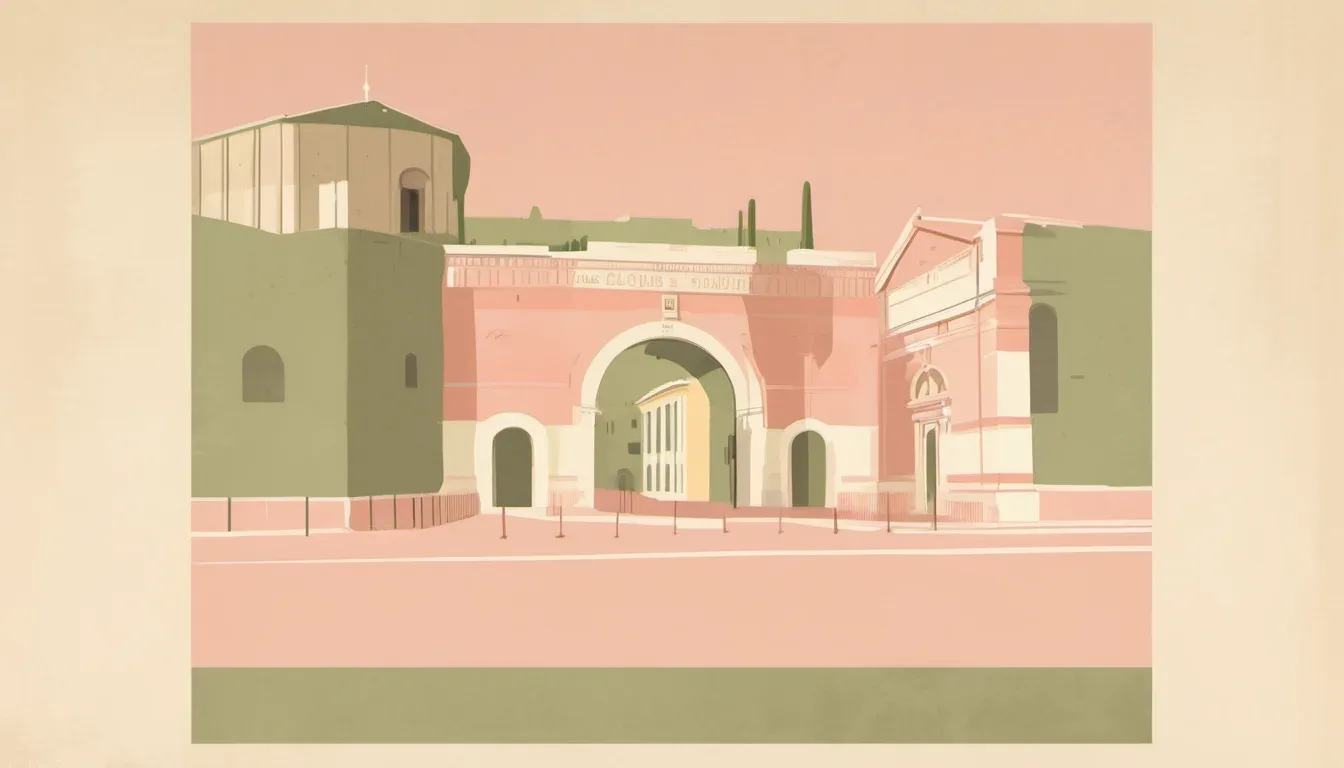
The arch stands at the point where the ancient Via Flaminia met the decumanus maximus. It is a city gate, not a triumphal arch, though its three vaults and monumental scale often confuse visitors. The central arch carried carts and horses; the side arches were for pedestrians.
Augustus ordered the gate built in AD 9, as recorded in a bronze-gilded inscription on the frieze. The same text mentions his titles and the gifting of the wall. The gate was the principal entrance to Colonia Julia Fanestris, a colony established in Fanum Fortunae, the town of the temple of Fortuna. The architect Vitruvius oversaw the colony's layout.
In 1463, during a siege by Federico da Montefeltro, cannon fire destroyed the attic. The fallen blocks were sold to the Confraternity of San Michele and used to build the adjacent church and loggia. The original appearance is preserved in a Renaissance bas-relief on the church facade, possibly based on drawings by the humanist Ciriaco d'Ancona.
Today the arch remains largely intact. You can still see the base of the lost attic, the horse-shoe shaped towers that flanked the gate, and the traces of the opus quadratum in Istrian stone. The keystone of the central arch bears a worn animal – probably an elephant. The gate is freely accessible, a quiet monument in the flow of city life.
The Arco di Augusto in Fano is a city gate disguised as a triumphal arch. Its three vaults – a large central opening flanked by two smaller ones – mark the point where the Via Flaminia once entered the Roman colony of Colonia Julia Fanestris. Inside the walls, the road became the decumanus maximus, the main east-west axis.
The gate was built in AD 9 by order of the emperor Augustus. An inscription on the frieze, with large bronze-gilded letters, records his titles and the gift of the wall: IMP. CAESAR DIVI F. AVGVSTVS PONTIFEX MAXIMVS COS. XIII TRIBVNICIA POTESTATE XXXII IMP. XXVI PATER PATRIAE MVRVM DEDIT. The architect Vitruvius, who planned the colony of Fanum Fortunae, is traditionally associated with the gate.
In the 4th century, the prefect Turcius Secundus Apronianus, under Constantine I, restored the gate and added a new inscription on the attic. That later epigraph is now lost, but the original Augustan text was not erased – a deliberate gesture linking two emperors.
The gate fell into obscurity until 1423, when the humanist Ciriaco d'Ancona stood before a crowd of citizens and translated the inscription. His study of the monument ensured that its original form was recorded before disaster struck.
Disaster came in 1463. During the Neapolitan succession war, the papal ally Federico da Montefeltro besieged Fano to unseat Sigismondo Pandolfo Malatesta. Cannon fire shattered the upper attic of the gate. The rubble was not used to rebuild the arch. Instead, the city sold the fragments to the Confraternity of San Michele, which used them to construct the facade of the adjacent church and its loggia.
The original appearance of the gate – with a full attic, a Corinthian pseudo-portico of seven arched windows and eight pseudo-columns – survives in a Renaissance bas-relief carved on the side of the church facade. It is hypothesized that the relief is based on Ciriaco d'Ancona's drawings, made before the destruction.
The gate is built of Istrian stone in opus quadratum. The central arch keystone is decorated with a relief of an animal, now too worn to identify with certainty; most scholars propose an elephant. On the rear side, a fragment of the attic still clings to the structure. The gate was once flanked by two horse-shoe shaped towers from which the city walls departed.
Adjacent to the arch stands the Palazzo del Cassero, built by the del Cassero family in the 14th century and renovated in 1930. The entire ensemble – gate, church, loggia, palace – forms a compact historical nucleus. Similar Augustan gates exist in Spello, Aosta, and Authon in Provence, but Fano's gate is one of the few to survive nearly intact.