Dazu Rock Carvings
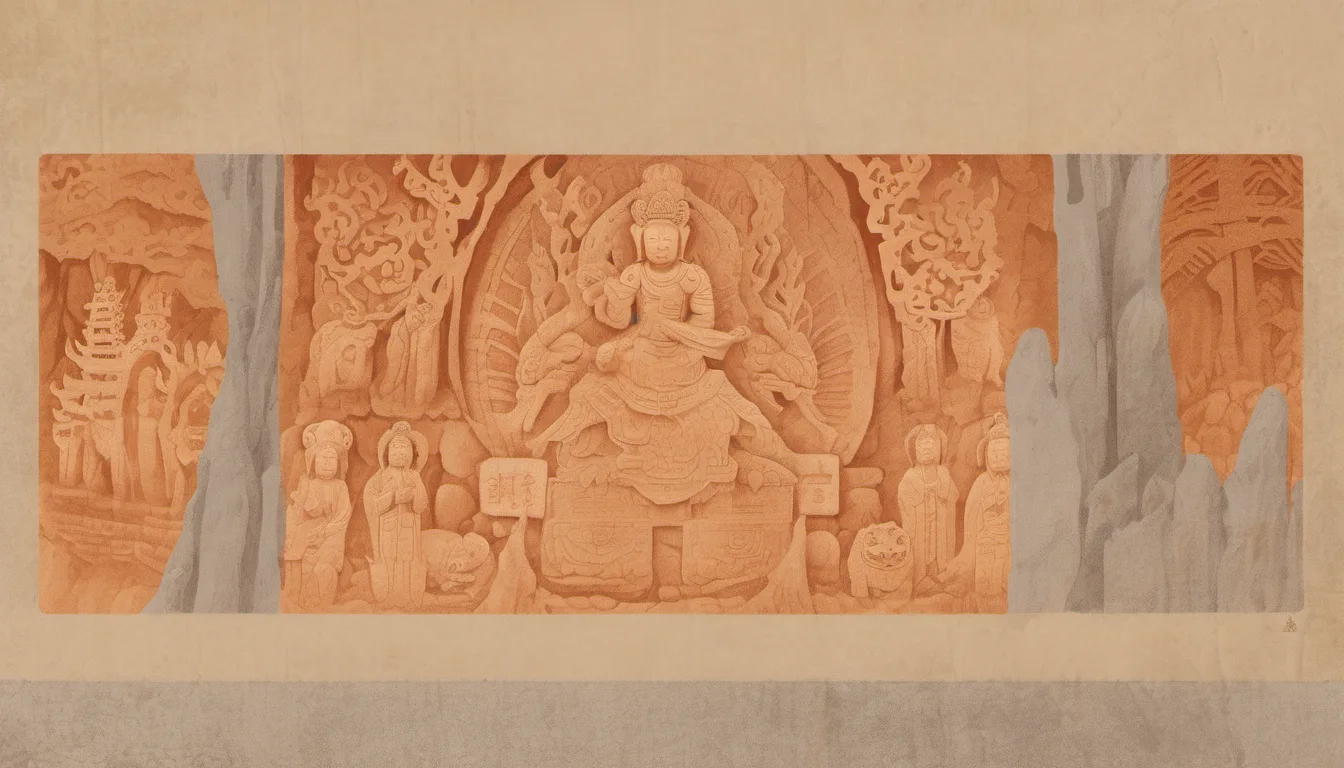
The Dazu Rock Carvings are a series of religious sculptures carved into the steep hillsides of Dazu District, about 165 km west of central Chongqing. Dating from the 7th century onward, they represent a unique fusion of Buddhism, Taoism, and Confucianism. UNESCO listed them in 1999, citing their aesthetic quality and the light they shed on everyday life in medieval China.
The carvings were pioneered in the late 9th century by Wei Junjing, Prefect of Changzhou, on Mount Beishan. His example was followed by locals, monks, and gentry during the Five Dynasties period. In the 12th century, the monk Zhao Zhifeng dedicated 70 years to the elaborate sculptures on Mount Baoding, creating a U-shaped valley of narrative reliefs stretching for 500 meters.
Five sites form the core: Beishan (a 300-meter cliff with Tantric Buddhist and Taoist motifs), Baodingshan (500 meters of secular and Tantric scenes), Nanshan (Taoist carvings and a stele recording a Mongol invasion), Shizhuanshan (unique integration of the three religions), and Shimenshan (statues of the Jade Emperor and other gods). Altogether, 75 protected sites contain about 50,000 statues and over 100,000 characters of inscriptions.
Off limits to visitors for many years, the rock carvings were opened to Chinese travelers in 1961 and to foreign visitors in 1980. Until 1975, only a muddy path connected Dazu town to the main clusters. A high-speed railway station is currently under construction, promising easier access to this remote, contemplative site.
On the steep hillsides of Chongqing’s Dazu District, an extraordinary assembly of stone figures has watched over the landscape for more than a millennium. The Dazu Rock Carvings, a UNESCO World Heritage site since 1999, comprise 75 protected sites containing some 50,000 statues and over 100,000 Chinese characters of inscriptions. They are not a single monument but a constellation of five distinct locations: Beishan, Baodingshan, Nanshan, Shizhuanshan, and Shimenshan.
The carvings date from the 7th century during the early Tang dynasty, though the main creative period began in the late 9th century. At that time, Wei Junjing, Prefect of Changzhou, initiated the carvings on Mount Beishan. After the Tang collapsed, monks, nobles, and ordinary people continued the work through the Five Dynasties and Ten Kingdoms period (907–65). In the 12th century, during the Song dynasty, the Buddhist monk Zhao Zhifeng devoted 70 years of his life to the elaborate sculptures on Mount Baoding, creating a U-shaped valley of narrative reliefs that stretch for 500 meters.
Each site offers a distinct experience. Beishan (North Mountain) presents two groups of carvings along a 300-meter cliff face, dating from the 9th to 12th centuries, with themes from Tantric Buddhism and Taoism. Baodingshan (Baoding Mountain) is the most dramatic: the figures in the U-shaped valley depict Tantric Buddhist teachings alongside scenes of secular life, a vivid record of Song-dynasty society. Nanshan (South Mountain) is dedicated to Taoist themes and symbols, and also holds a stele that records the history of Sichuan after a Mongol invasion in the 13th century.
Shizhuanshan (Shizhuan Mountain) stands out for its unique integration of Taoism, Confucianism, and Buddhism in a single site. The most prominent sculptures here are thought to have been carved by Wen Wijian, a famous sculptor of the time – a legend that adds a personal dimension to the work. Shimenshan (Shimen Mountain) includes statues of the Jade Emperor and several gods, dating from the 12th century.
Unlike most Chinese rock carving collections, Dazu is remarkable for including all three major religions in one place. The UNESCO citation praises the harmonious synthesis of Buddhism, Taoism, and Confucianism, as well as the secular scenes that illuminate everyday life during the period. The carvings also bear over 100,000 characters of inscriptions and epigraphs, making them a historical archive as well as an artistic one.
For many years, the carvings were off limits. They were opened to Chinese travelers only in 1961, and to foreign visitors in 1980. Until 1975, the only way to reach the main cluster from Dazu town was a muddy path – a detail that hints at the isolation that helped preserve the site. Today, a high-speed railway station (Dazushike) is under construction on the Chengdu-Chongqing Central line, which will make this remote treasure more accessible.
A visit to Dazu is a journey into a world where stone, faith, and daily life merge. The scale is overwhelming: 50,000 statues spread across five mountains, each with its own character. Whether you stand before the 500-meter reliefs at Baodingshan or trace the 300-meter cliff at Beishan, the carvings demand quiet contemplation. The legends, the history, and the sheer craftsmanship linger long after you leave.