Teatro Lauro Rossi
In Macerata, the old civic palace hides a theatre. It began in 1765, when forty-six noble co-owners subscribed to build a larger opera house on the same site. They wanted the most celebrated theatre architect of the moment, Antonio Galli da Bibbiena. His plan proved too grand for the available space, so Cosimo Morelli adapted it. The theatre opened on 2 January 1774 with Metastasio's L'Olimpiade, set to music by Pasquale Anfossi.
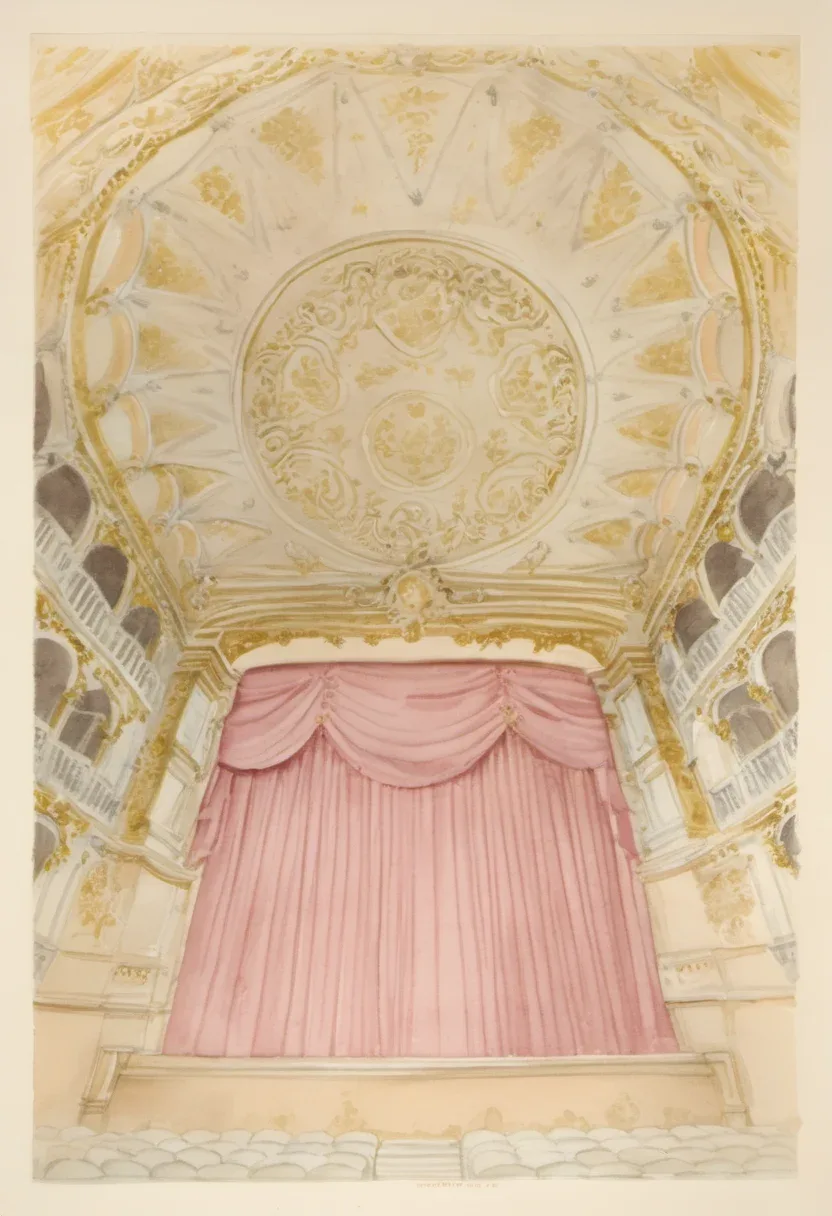
The building's shape is its signature: a bell-shaped auditorium with four tiers of boxes. The first theatre on the spot had been built in 1663 and rebuilt a year later to designs by Giacomo Torelli, a set designer from Fano. Over the following century, the audience outgrew it. The theatre you see today carries the older memory inside its walls.
In the 19th century the theatre changed character. In 1855 the fourth tier was converted from private boxes into a loggione. In 1870 the stalls floor was tilted for better view and acoustics, the stage was enlarged, and a lifting chandelier was installed. Two years later the municipality took ownership, ending the era of box-holders. In 1884 the house was named for Lauro Rossi.
The last major restoration, from 1984 to 1989, uncovered the original 18th-century polychrome stuccoes beneath six layers of paint. Samoggia's ceiling decoration was revised for coherence. Today the theatre is one of the venues employed by the Sferisterio – Macerata Opera Festival and part of the condominio theatres recognised by UNESCO. You can still sit in a box and imagine the first night of L'Olimpiade.
Macerata's old civic palace does not look like a theatre from the street. It looks like a small town's public building, sturdy and calm. Then you pass inside, and the room unfolds: a bell-shaped auditorium, four tiers of boxes, a painted ceiling. This is Teatro Lauro Rossi, an opera house that has been patiently repaired for more than two centuries.
The first theatre on the site came in 1663, inside what was then the Palazzo Comunale. It opened on 31 August, the feast of Macerata's patron saint, following a design inspired by the theatres of Venice. It was too small. In 1664 it was demolished and rebuilt to drawings by Giacomo Torelli, a Fano set designer who had been architect to the King of France.
By 1765, the public had outgrown the rebuilt theatre. Forty-six noble co-owners subscribed to create a new one on the same spot, in a wider form. The commission went to Antonio Galli da Bibbiena, the era's best-known theatre architect, fresh from his great work at the Teatro Comunale in Bologna. His project, however, was too large for the space available. Cosimo Morelli was called in to adapt it. He kept the bell-shaped floor plan and the four tiers of boxes that had been Bibiena's ideas, and he finished the work in 1772.
The official opening came on 2 January 1774. The inaugural opera was L'Olimpiade by Pietro Metastasio, with music by Pasquale Anfossi. For Macerata, it was a proudly civic moment. But the building was not yet fully public. The boxes belonged to a private company of shareholders, and the theatre was open to all while remaining an aristocratic property.
The 19th century slowly turned it into a communal possession. In 1833, Pietro Ghinelli introduced the elegant tenaglia staircase. In 1855, Agostino Benedettelli reduced the fourth tier of boxes to a loggione, cutting the seats reserved for noble co-owners. It was the first clear move from a private conception of theatre to a social, public one.
Another restoration began in 1870 under Mario Monti, an engineer who had worked with Giuseppe Mengoni on Milan's Galleria Vittorio Emanuele, and the decorator Luigi Samoggia. They tilted the previously flat stalls floor for better views and acoustics, enlarged the stage, and installed a rising chandelier. In 1872 the municipality bought the theatre. Twelve years later, it was dedicated to Lauro Rossi, a composer born in Macerata. Rossi died the following year.
Between 1984 and 1989, the city set out to restore the building's original design. Workmen stripped away six layers of paint and found the 18th-century polychrome stuccoes almost intact underneath. Samoggia's ceiling decorations were revised to make them more homogeneous, and materials and colours were chosen as close to the originals as possible.
Today the Teatro Lauro Rossi is used by the Sferisterio – Macerata Opera Festival. It is also, according to UNESCO's 2026 listing, part of the chain of 'condominio theatres' that runs through Marche, Umbria and Emilia-Romagna. The phrase sounds odd in English; it describes the shared-ownership opera houses that central Italy built in the 18th and 19th centuries. The theatre remains a compact, human-scaled room. Stand in the stalls and look up at the boxes. You are standing where a century of performances began, and the audience is still watching.