Rani ki Vav
Walk down seven flights of stairs into a world carved from stone. Rani ki Vav is not a well you draw water from—it is a descent into an inverted temple, where the walls teem with gods, goddesses, and ordinary women lost in their daily rituals. The Chaulukya queen Udayamati built it in the 11th century, likely after her husband Bhima I died, though the story is disputed. The stepwell was flooded by the Saraswati River, silted over, and forgotten until the 1940s, when excavations began.
The architecture is deliberately sacred. Each of the seven levels brings you closer to the water, symbolising a journey from the earthly to the divine. More than 500 principal sculptures line the walls—Vishnu in his cosmic form, celestial dancers, a woman writing a letter, another warding off a monkey clinging to her leg. The detail is relentless, even obsessive. The stepwell is classified as a Nanda type, measuring 65 metres long, 20 metres wide, and 28 metres deep.
After restoration in the 1980s by the Archaeological Survey of India, the stepwell gained UNESCO status in 2014. It now appears on the ₹100 banknote. But the real monument is the descent itself—each step a reminder that water was once revered as a divine gift, not a utility. You leave with dust on your shoes and the face of an apsara in your mind.
In the parched landscape of northern Gujarat, the idea of an underground temple devoted to water feels both audacious and inevitable. Rani ki Vav, the Queen's Stepwell, is a place you enter by going down. The entrance is modest—a simple opening in the earth. But once you step onto the first of seven stair levels, the scale reveals itself. The corridor is compartmentalised with pillared pavilions, each level offering a new set of sculptures, as if the entire universe is being unfolded before you.
The stepwell was built under the Chaulukya dynasty, commissioned by Udayamati, the queen of Bhima I. The Jain monk Merutunga, in his 1304 text *Prabandha-Chintamani*, wrote that she built it 'surpassing the glory of the Sahasralinga Tank'. Whether she was a widow when she began is unclear—the sources are ambiguous. What is certain is the effort: the well shaft alone is 30 metres deep and 10 metres in diameter. The entire structure sinks 28 metres into the ground, as if the builders were trying to reach the source of life itself.
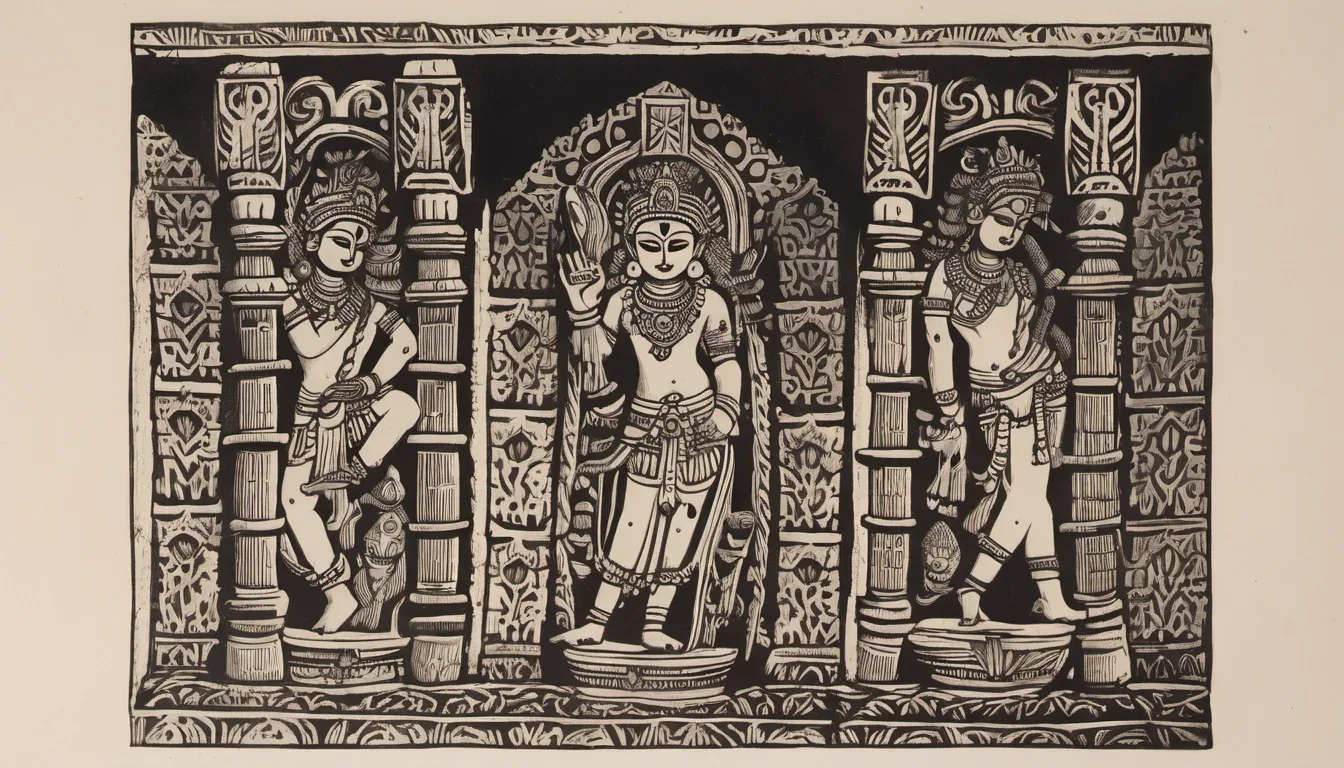
The sculptures are the soul of Rani ki Vav. Over 500 principal figures and more than a thousand minor ones cover the walls, pillars, brackets, and beams. Hindu deities predominate: Vishnu appears again and again—reclining on the serpent Shesha, in his cosmic form, and in all ten incarnations. But alongside the gods are scenes of everyday life: a woman combing her hair in a mirror, another writing a letter, a young woman with a scorpion climbing her leg. There is a woman emerging from her bath, water droplets falling like pearls, caught by a swan. These are not mere decorations; they are a record of a world that once was.
One of the most arresting sculptures shows an apsara warding off a monkey clinging to her leg. At her feet, a nude woman has a snake around her neck. Another apsara applies lip paint (or chews an aromatic twig) while a man attends to her feet. The artisans mixed the sacred with the intimate, the celestial with the earthly. The women in these panels wear elaborate jewellery—bangles, earrings, girdles—and their expressions range from maternal tenderness to amused seduction. The stepwell is also a gallery of maternal love: a mother points to the moon to distract her child; another lifts her son to pluck a mango.
The stepwell suffered a long silence. After the city of Patan was sacked by Qutb-ud-din Aibak between 1200 and 1210, and again by Alauddin Khilji in 1298, the Saraswati River flooded the structure. By the 1890s, when the British archaeologists Henry Cousens and James Burgess visited, only the well shaft and a few pillars were visible above ground. They described it as a huge pit 87 metres across. James Tod noted that the stepwell's material had been reused in another well in modern Patan.
Rediscovery came in the 1940s, when excavations by the Baroda State revealed the buried stairways. More extensive restoration by the Archaeological Survey of India between 1981 and 1987 brought the sculptures back to light. An image of Udayamati herself was recovered—the queen who had built the well was finally seen again. In 2014, UNESCO listed the site; in 2016, it was named India's Cleanest Iconic Place.
Today, Rani ki Vav is peaceful. The water level is low; the steps are dry. You can walk down to the deepest level, where a rectangular tank waits. The air becomes cooler as you descend, and the carvings grow denser. The latticework on the northern entrance echoes the patterns of Patola textiles—geometric, intricate, local. The stepwell's architecture shares similarities with the Vimalavasahi temple on Mount Abu and the Sun temple at Modhera, all built in the Maru-Gurjara style.
There is a quiet lesson here: that a queen's grief, or ambition, or devotion—whatever drove her—could result in a structure that outlasts empires. Rani ki Vav is not a place for rushing. It rewards those who pause at each level, who let their eyes follow the scrollwork, who wonder about the woman with the scorpion and the monkey. The stepwell is a descent into history, and a reminder that the best things are often hidden, waiting to be uncovered.