Sinagoga del Tránsito
The Sinagoga del Tránsito, also known as the Synagogue of Samuel ha‑Levi, was completed in 1357. Designed by master mason Don Meir Abdeil, it served as an annex to the palace of Samuel HaLevi, treasurer to King Peter of Castile. Located in Toledo’s former Jewish quarter, it is one of three preserved synagogues built under Christian rule.
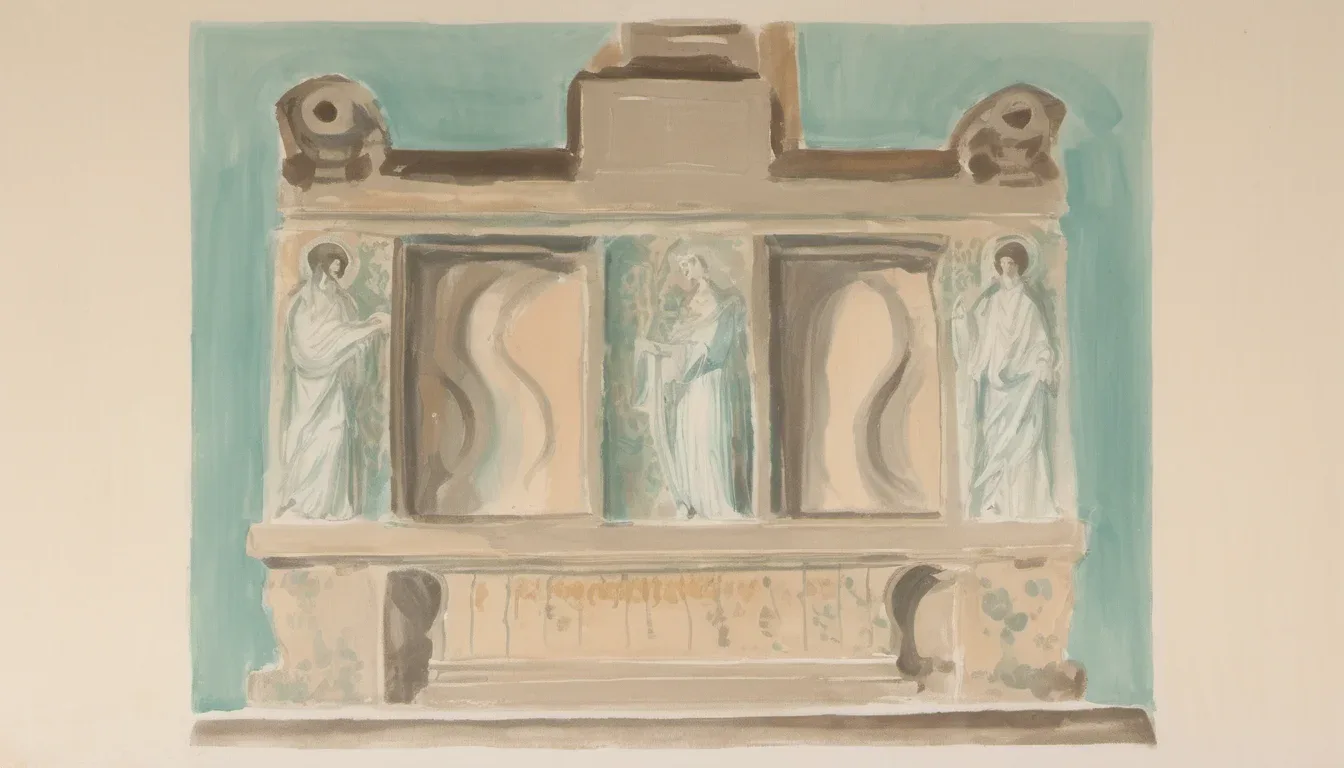
Stepping inside, you enter a rectangular hall 23 by 9.5 metres with a 12‑metre‑high ceiling. Every surface is covered in Nasrid‑style polychrome stucco, multi‑foil arches, and a massive Mudéjar artesonado ceiling. Hebrew inscriptions praise the king and Samuel; Arabic inscriptions in Kufic script offer devotional phrases. A second‑floor women’s gallery opens toward the hekhal—the Torah ark—whose three‑panel façade features a sebka motif and muqarnas cornices.
After the 1492 expulsion of Jews from Spain, the synagogue was converted into a church dedicated to Saint Benedict, later renamed Nuestra Señora del Tránsito after a painting by Juan Correa de Vivar. It was briefly a military barracks during the Napoleonic Wars. In 1877 it became a national monument, and by 1910 it was transformed into the Sephardic Museum, which remains today.
The exterior is deliberately unremarkable: brick and stone walls, a plain facade, and an aljima window over the door. Only the tall roof hints at the richness inside. Allow an hour to absorb the stucco, the cedar woodwork, and the quiet weight of centuries.
Toledo’s old Jewish quarter holds three surviving synagogues from the 14th century. The Sinagoga del Tránsito is the most ornate. Built in 1357 as a private house of worship for Samuel HaLevi—an Abulafia, descended from kabbalists and Torah scholars—it was also a yeshiva. A gate connected it to Samuel’s palace.
Samuel served as treasurer and counselor to King Peter of Castile. Some scholars suggest the king allowed the synagogue’s construction as a token of appreciation or to compensate Toledo’s Jews for persecution during the Black Death of 1348. This happened despite regional councils prohibiting synagogue construction. Why it was permitted remains debated: Samuel’s relationship with Peter, the fact it was private, or that it was built over an older synagogue—a loophole. Samuel later fell out of favour, was arrested in 1360, and tortured to death in Seville.
The prayer hall is rectangular, 23 by 9.5 metres, with a 12‑metre ceiling. The Mudéjar artesonado ceiling is massive. Nasrid‑style polychrome stucco covers the walls, interspersed with Hebrew and Arabic inscriptions—the Hebrew praises king and patron, the Arabic offers devotional affirmations. Christian elements appear too: muqarnas ornament mixed with heraldry and vegetal motifs. Samuel’s coat of arms borrows from Christian custom.
Women attended services separately, in a second‑floor gallery along the southern wall. Five broad openings look down toward the hekhal, the Torah ark. The hekhal is a design innovation: a great facade with three vertical panels, a central sebka motif, and muqarnas cornices with vegetal and garden motifs. The ark is made of cedar wood, its eastern wall divided into six pieces.
In deliberate contrast, the exterior is plain. Brick and stone walls are simple and unadorned. An aljima window—a pair of horseshoe arches—sits over the entry door. The building does not stand out, save for its tall roof rising slightly above neighbours.
In 1492, after the expulsion of Jews from Spain, the synagogue was converted into a church. Ferdinand and Isabella gave it to the Order of Calatrava, which is said to have dedicated it to Saint Benedict. It acquired the name El Tránsito from a painting of the Transit of the Virgin by Juan Correa de Vivar. In the 17th century it was called Nuestra Señora del Tránsito.
During the Napoleonic Wars it served as military barracks. Restoration began in 1879, cleaning the Torah ark and repairing lattices. In 1910 the Vega‑Inclan Foundation initiated its transformation into the Sephardi Museum; a 1964 royal decree established the Museo Sefardi, later renamed the National Museum for Hispanic‑Hebraic Art. The building is well conserved and remains a museum.
The architecture of El Tránsito influenced other 14th‑century synagogues, such as the one in Córdoba, which copied the three‑panel hekhal design and Mudéjar style. Today it stands as a national monument and a rare window into the Jewish, Christian, and Islamic threads of medieval Spain.