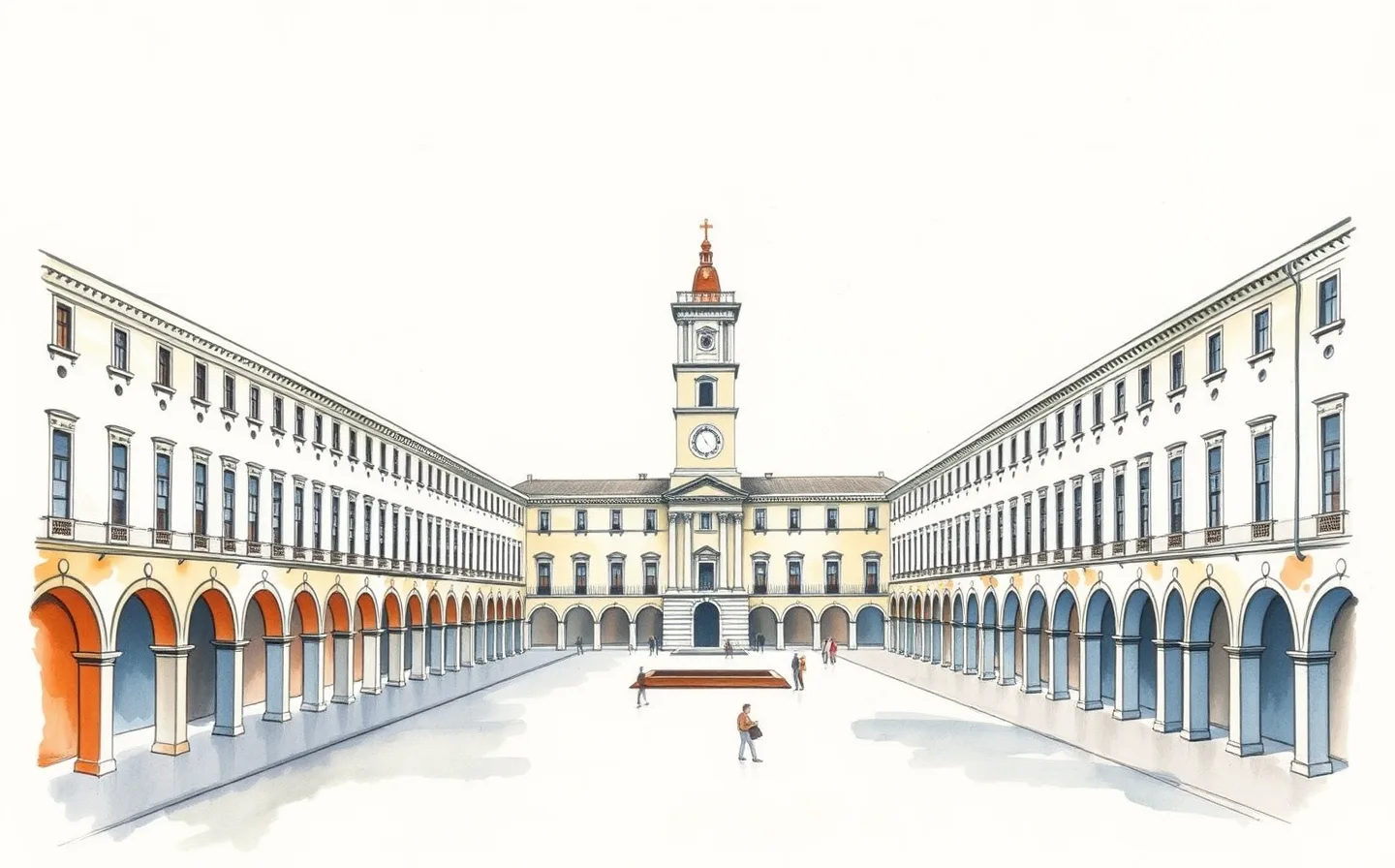
The reconstructed Clock Tower stands as a symbol of Faenza's resilience and Neoclassical order.
Faenza, Italy
Faenza does not shout. It sits at the foot of the first Apennine slopes, a quiet node on the Via Emilia where the Po Valley meets the hills. The city’s identity is not found in grand gestures, but in the steady rhythm of its ceramic tradition. Here, the earth is not just dug; it is translated. The very word for fine pottery, faience, carries the city’s name, a testament to a craft that has defined its economy and soul for centuries.
What makes Faenza matter is its architectural silence. While much of Italy clings to the ornate excesses of the Baroque, Faenza turned inward during the 18th and 19th centuries. Architects like Giuseppe Pistocchi and Giovanni Antonio Antolini stripped the city’s bones clean, imposing a severe, rational Neoclassicism that rivals Paris. This is not a city of decoration, but of proportion. The Palazzo Milzetti stands as the finest example, a temple to reason in a land of passion.
Walking Faenza rewards those who look for the geometry beneath the surface. The urban fabric still echoes the Roman cardo and decumanus, a grid laid down two millennia ago. You move from the quadrangular Clock Tower, reconstructed after 1944, to the Main Fountain’s bronze eagles. It is a walk through time, but not a noisy one. It is a conversation between the Manfredi family’s medieval power, the papal orders, and the modern pursuit of material innovation. You leave with the dust of ceramics on your shoes and the calm of Neoclassical order in your mind.
To understand Faenza, one must first accept that it is a city of two distinct eras. The first is medieval, rooted in the Roman colony of Faventia. The second is Neoclassical, a deliberate reinvention that occurred two thousand years later. Today, the city’s 58,746 inhabitants live in a landscape where the original Roman grid is still legible in the street patterns, yet the buildings above are predominantly 18th- and 19th-century interpretations of Greek and Roman order.
The city’s early history is etched in conflict. From the 2nd century BC, it was a Roman settlement. By the Middle Ages, the Manfredi family had consolidated power, turning Faenza into a ghibelline stronghold against the Empire. Frederick II of Svevia besieged the city multiple times in the 13th century, ordering the destruction of its walls. Yet, the city persisted. Dante Alighieri, in the *Divine Comedy*, referenced several Faentines, including Tebaldello Zambrasi and Frate Alberigo, anchoring the city in the literary consciousness of Europe. The Manfredi rule ended in 1500 with the siege of Cesare Borgia, after which Faenza passed to Venice and eventually the Papal States.
It was under the Papal States that Faenza underwent its most profound transformation. In the 18th and 19th centuries, the city became a leading center of Neoclassicism in Europe. This was not an accident of taste but a political and cultural statement. Architects Giuseppe Pistocchi, Giovanni Antonio Antolini, and Pietro Tomba led a campaign of urban regeneration. They did not merely build; they reimagined the city’s civic identity. The result is a architectural coherence that is rare in Italy. The Palazzo Milzetti, housing the National Museum, stands as the supreme example of this rationalist vision.
The center of this civic order is Piazza del Popolo. Here, the Clock Tower (Torre dell’Orologio) rises, a quadrangular structure with five superimposed orders and a dome. Its current form is a faithful reconstruction from 1953, following its destruction by retreating German forces in November 1944. The tower retains the original 17th-century marble statue of the Madonna with Child by Francesco Scala, which survived the collapse. Adjacent to it, the Main Fountain, completed in 1621 by Domenico Castelli, features bronze sculptures by Tarquinio Jacometti. The eagles and dragons represent Pope Paul V, while the three rampant lions symbolize the city’s coat of arms.
Beyond the center, the city’s ceramic tradition remains its economic and cultural backbone. Recognized by the National Ceramic Council, Faenza received the designation of “UNESCO Creative City for Crafts and Folk Art” in October 2025. This is not merely a title but a living practice. The economy integrates advanced materials, environmental sustainability, and agricultural technology with its historic craft. The landscape itself, with vineyards on the hilly slopes and cultivated plains showing traces of Roman centuriation, reflects this blend of old and new. To walk Faenza is to walk through a continuous process of regeneration, from its Roman origins to its modern status as a hub of innovation.