Mausoleum of Galla Placidia
That ceiling above you is a night sky nobody has repainted in over fifteen hundred years: deep-blue glass tesserae, roughly five hundred seventy gold stars, a gold cross dead center, lit by nothing but thin sheets of alabaster standing in for window glass. This plain brick box, almost windowless from the street, holds one of the best-preserved mosaic interiors anywhere from the ancient world.
It takes its name from Galla Placidia — daughter of one emperor, sister of another, regent for her own son for twelve years after 425, and one of the most powerful women of the collapsing Roman West. She likely paid for this building as a chapel attached to a church that has since vanished. Here's the twist: she almost certainly isn't buried here. She died in Rome in 450, and the record points to a tomb near Old St Peter's. The three marble sarcophagi inside are tradition, not proof.
The story goes that in 1577, local children peering into the largest sarcophagus with a lit candle accidentally burned what was inside to ash — said to be an embalmed body, seated upright on a wooden chair. Whose body, and whether the story is even true, nobody can say.
What's certain is the context: fifth-century Ravenna was capital of a Western Empire that could no longer defend its own borders, yet could still afford lapis-blue glass and gold tesserae by the thousand. Look up. That sky has outlasted the empire that paid for it by fifteen centuries.
Look up for a moment. That dome is deep-blue glass, scattered with roughly five hundred seventy gold stars circling a plain gold cross, and it has held that color since somewhere around the year 425. Nothing has repainted it, nothing has restored the blue. By most reckonings, it's the oldest surviving mosaic ceiling in the world still close to its original state.
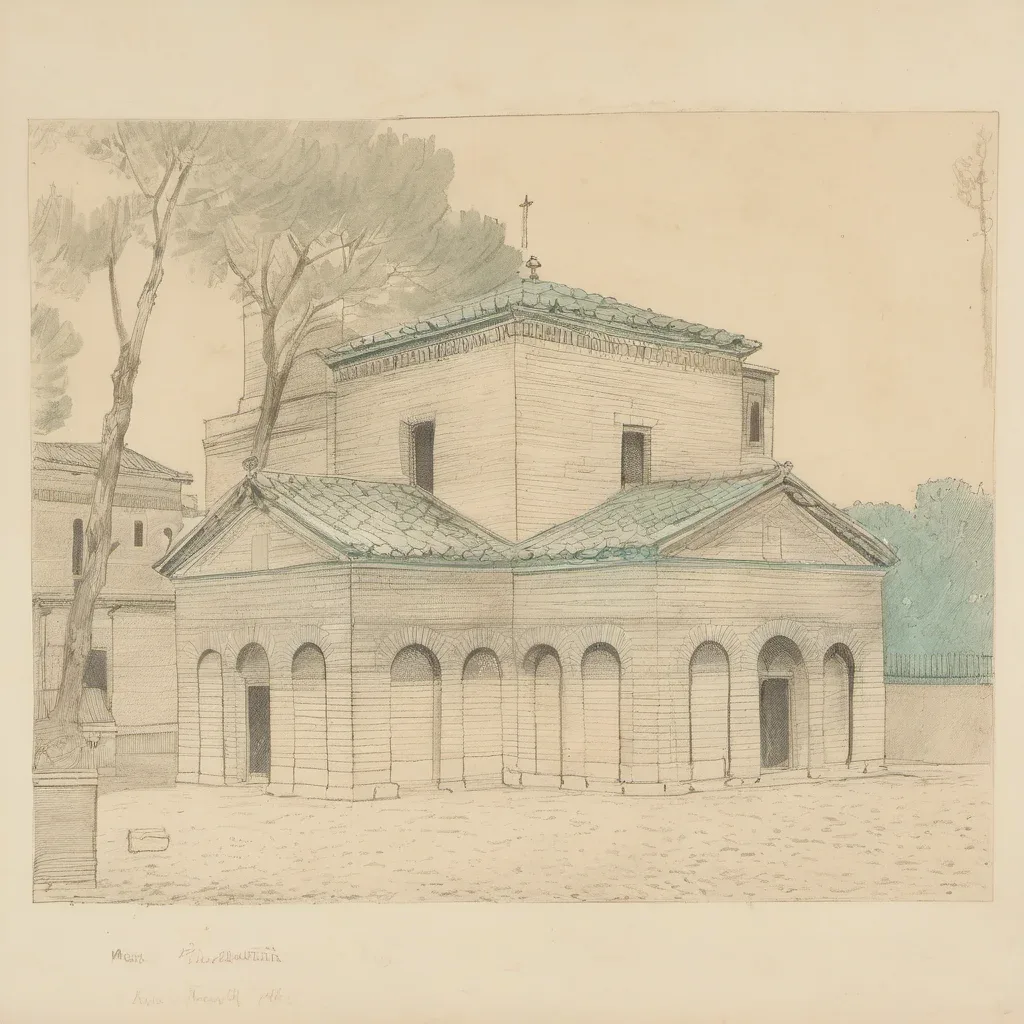
Notice, too, how warm the dim light in here feels. There's no glass in the window openings, only thin sheets of alabaster, cut fine enough that daylight bleeds through amber and gold rather than white. Outside, the building gives nothing away — plain brick, blind arcades, no dome visible from the street, a cross-shaped footprint just under thirteen meters on its long axis with a squat lantern tower stitched over the crossing. That contrast, humble outside and molten gold within, was deliberate. Christian Ravenna kept spending on the inside of its buildings even as the empire outside was running out of almost everything else.
The building carries the name of Galla Placidia, and her life alone earns the five minutes you're allowed inside. Daughter of the emperor Theodosius I, she was taken by Visigothic raiders as a young woman and ended up marrying her captor, King Athaulf. Widowed, she was traded back to Rome, married again to the general Constantius, and when her son Valentinian III inherited the throne as a child in 425, she ruled the Western Empire in his name for the next twelve years. Whether she personally funded this chapel is still argued over, but the strength of the tradition tells you how large she loomed in this city's memory.
Here's the part that surprises most visitors: she is almost certainly not buried here. Galla Placidia died in Rome in 450, and the historical record points to a tomb near Old St Peter's Basilica, not this building. The belief that she rests in one of the three marble sarcophagi against these walls hardened into popular fact around the thirteenth century and never fully let go — even though scholars now think this space first served as an oratory, likely dedicated to St Lawrence, attached to the narthex of a much larger church, Santa Croce, that barely survives today.
That hasn't stopped legends from sticking to the sarcophagi themselves. The story goes that in 1577, children peering through a crack in the largest one with a lit taper accidentally set fire to what was inside — said to be an embalmed body, dressed in imperial robes, seated upright on a chair of cypress wood. Within minutes, whatever was there was ash. Whether that body belonged to Galla Placidia, or to anyone in particular, nobody can say for certain. It's a story Ravenna tells with a shrug: dramatic, uncorroborated, impossible to fully dismiss.
Turn toward the entrance lunette and you'll find one of the strangest images in early Christian art: Christ as the Good Shepherd, young, beardless, dressed in gold and imperial purple, resting among his flock with the relaxed posture of a Roman aristocrat rather than a king. It's among the earliest surviving versions of that scene, painted at the exact moment Christian art was still deciding whether its central figure should look like a shepherd or an emperor. Elsewhere, two stags bend to drink from a fountain, a visual echo of a psalm about longing for water, worked in glass tesserae so small that a single square meter can hold tens of thousands of them.
Why build something this rich, this small, hidden behind blank brick, in a marsh town on the Adriatic? Because Ravenna, not Rome, was the capital of the Western Roman Empire by then — a defensible swamp city the court retreated to as the frontiers kept shrinking. This building is what an empire spends its last resources on when it can no longer hold its borders but still wants to be remembered: not armies, but a ceiling of gold stars on blue glass, built to outlast every ruler who ever stood beneath it. It has. Step back out into the plain brick and the ordinary daylight, and that sky stays with you anyway.