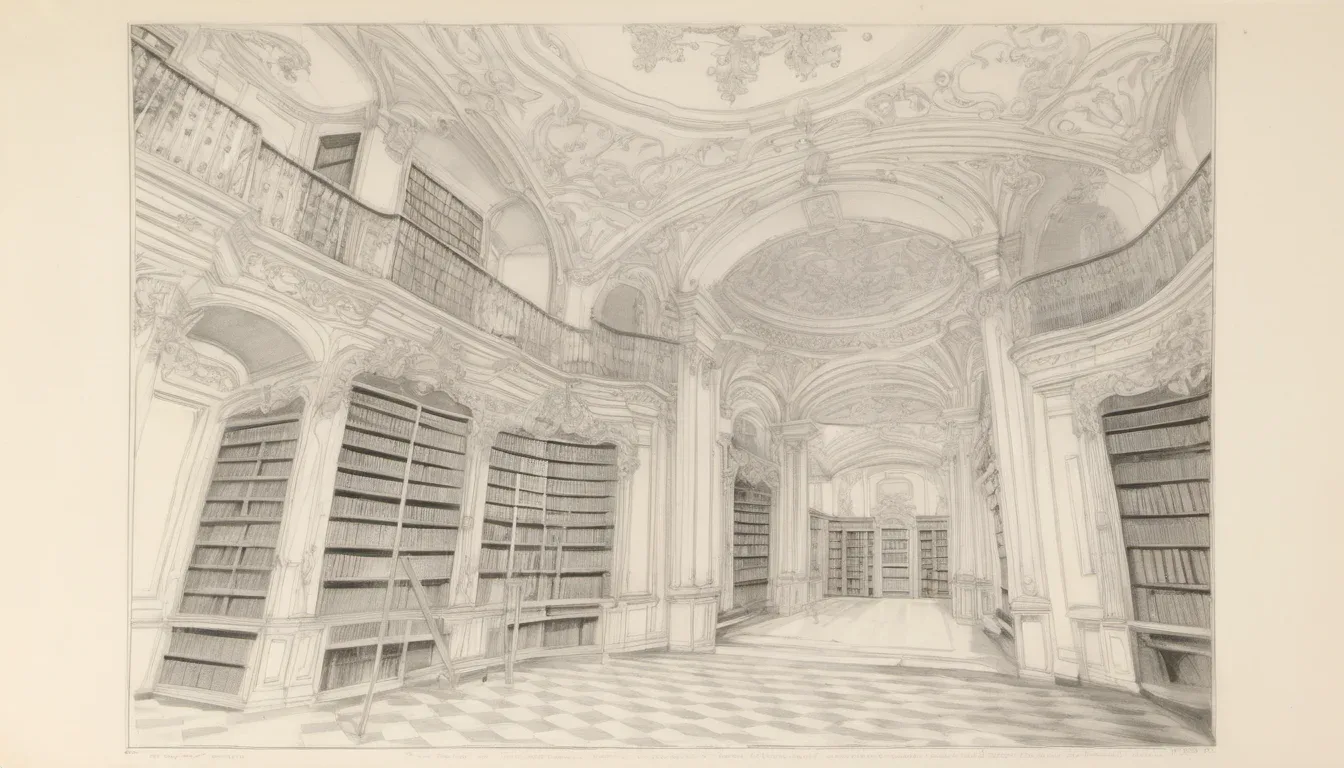
Stift Admont Library
Admont Abbey rises where the Enns River meets the Gesäuse mountains, its name derived from the Latin ad montes — at the mountains. Founded in 1074 by Archbishop Gebhard of Salzburg on land given by Hemma of Gurk, it is the oldest monastery still standing in Styria. Monks from St. Peter's Abbey in Salzburg settled it under Abbot Isingrin, and dedicated the house to Saint Blaise. Everything since has been built on and around that first act of settlement.
The abbey's second abbot, Giselbert, is said to have brought the Cluniac reforms here — an early instance of Admont doing things at a remove from Rome's usual timetable. His successor Wolfhold founded a school for the daughters of noble families, and teaching never really left the place after that. A scriptorium kept pace with the monastery's growing ambitions through the Middle Ages, producing manuscripts under abbots including Engelbert of Admont, who ran the house from 1297 to 1327 and wrote prolifically enough to be remembered as a scholar first and an administrator second.
War with the Ottoman Empire and the upheavals of the Reformation slowed things considerably — one abbot, Valentine, was forced out for his Reformed sympathies. The Counter-Reformation reversed the decline, and the seventeenth and eighteenth centuries became Admont's high style: theology and philosophy faculties, a secondary school later moved to Judenburg, and workshops turning out embroidery from Brother Benno Haan and sculpture from Josef Stammel. Abbot Albert von Muchar, later a professor at the University of Graz, wrote its history.
Then, on 27 April 1865, fire took almost the entire monastery. The archives burned. The library, remarkably, did not. Reconstruction started the following year and dragged on past 1890 — long enough that the abbey's current church, designed by Wilhelm Bücher with west towers standing 67 metres tall, is itself a monument to the fire rather than a survivor of it. The twentieth century brought further trouble: the abbey sold off art to survive the economic crises of the 1930s, and the Nazi government dissolved the community outright, evicting the monks. They returned in 1946, and the community endures — 26 monks, under Abbot Gerhard Hafner, as of last year.
What the fire spared, and what reconstruction then had to house, is the reason to come: a library hall completed in 1776 to designs by Joseph Hueber, 70 metres long beneath seven frescoed cupolas by Bartolomeo Altomonte. It holds roughly 70,000 of the abbey's 200,000 volumes, more than 1,400 manuscripts, and upward of 900 incunabula — enough that Admont describes its collection as the largest monastic library on earth. Downstairs, a stranger inheritance: a natural history museum built up almost single-handedly by Father Gabriel Strobl after 1865, whose insect collecting turned into one of Europe's three largest holdings of flies.
Admont Abbey stands on the Enns River in Styria, hard against the edge of Gesäuse National Park — appropriately, since its name comes from the Latin ad montes, at the mountains. It is the oldest monastery still standing in the province, and centuries of rebuilding have left it known chiefly for Baroque architecture, art, and manuscripts, alongside a long-established scientific collection. Together they add up to a library the abbey itself describes as the largest monastic collection in the world.
The house was founded in 1074 by Archbishop Gebhard of Salzburg, on land left by Hemma of Gurk, and settled by monks sent from St. Peter's Abbey in Salzburg under Abbot Isingrin. It was dedicated to Saint Blaise, whose figure still tops the west door of the church nine hundred years later. The founding itself was modest — a land grant, a handful of monks, an abbot on loan from another house — but it set a pattern of outside patronage and careful stewardship that carried Admont through several near-endings.
Giselbert, the second abbot, is said to have introduced the Cluniac reforms to the community — a detail the record hedges rather than states outright. What is clearer is the work of Wolfhold, another early abbot, who founded a convent school for girls of noble family; the educational tradition he started never really lapsed. Alongside it, a scriptorium turned Admont into a working centre of medieval scholarship, reaching a peak under Abbot Engelbert, who governed from 1297 to 1327 and left behind a body of written work substantial enough that he is remembered today as a scholar who happened to run a monastery, not the other way around.
None of that continuity was guaranteed. Wars against the Ottoman Empire and the disruptions of the Reformation dragged the abbey through a long decline — Abbot Valentine was pushed out over his Reformed sympathies — before the Counter-Reformation reversed the slide. Admont rebuilt itself as an institution of learning: faculties of theology and philosophy, a secondary school that later relocated to Judenburg, and, later, the historian-abbot Albert von Muchar, who taught at the University of Graz while writing the house's history.
The seventeenth and eighteenth centuries were the abbey's artistic high-water mark. Brother Benno Haan, an ecclesiastical embroiderer working from 1631 to 1720, and the sculptor Josef Stammel both produced work here that spread Admont's reputation well past Styria. In 1641 the abbey formally joined the Salzburg Congregation, a Benedictine grouping that would itself be absorbed, in 1930, into the present-day Austrian Congregation of the Benedictine Confederation — one more instance of Admont outlasting the institutions built around it.
Then, on 27 April 1865, fire tore through almost the entire monastery. The monastic archives burned. The library — improbably, given the scale of the loss — was carried to safety. Reconstruction began the following year and was still unfinished by 1890, a quarter-century of rebuilding that reshaped Admont as thoroughly as any of its medieval refoundations.
The church that rose from that rebuilding was designed by the architect Wilhelm Bücher: twin west towers 67 metres tall, a facade carrying figures of Saint Benedict and Saint Scholastica, and Saint Blaise himself set above the west door. Inside, a central aisle runs between two side aisles lined with five chapels and six altars apiece. Martino Altomonte painted the Maria Immaculata that hangs on the altar of Mary; a statue of Saint Blaise stands atop the high altar, carved in white Carrara marble; the choir is hung with tapestries Benno Haan made in the early eighteenth century; and in the Chapel of Saint Benedict there is a Baroque Corpus Christi from the workshop of Johann Meinrad Guggenbichler. Buried within the abbey are its founder, Gebhard of Salzburg, the scholar-abbot Engelbert of Admont, Anastasia of Kiev, and Conrad of Babenberg — an unusually well-connected roster for a monastery this far from any capital.
The twentieth century tested Admont again. The economic crises of the 1930s forced the sale of a considerable share of its art treasures, and under the Nazi government the monastery was dissolved outright and its monks evicted — a rupture the community did not recover from until 1946, when the monks returned and rebuilt the community from there. Today it is once again a working Benedictine house: 26 monks, as of July 2025, under Abbot Gerhard Hafner.
The library hall is the reason the abbey's name travels further than most. Built in 1776 to designs by the architect Joseph Hueber, it runs 70 metres long, 14 wide, and 13 high, its ceiling carried on seven cupolas frescoed by Bartolomeo Altomonte. It holds around 70,000 of the monastery's roughly 200,000 volumes, alongside more than 1,400 manuscripts and upward of 900 incunabula — the numbers behind Admont's claim to the largest monastic library anywhere. The scale is the point: shelving enough, in theory, to make good on the superlative even before you count what else the abbey holds.
Downstairs, in effect, is a second collection built entirely out of catastrophe. The abbots had gathered curiosities and scientific specimens since the Baroque period, and every one of them was destroyed in the 1865 fire. It was Father Gabriel Strobl, tasked with reconstruction, who decided to start again — a botanist by training who ended up one of the more significant entomologists of his generation. The natural history museum he founded now holds more than 250,000 insect specimens, including one of the three largest fly collections in Europe, a strange and specific legacy for a Benedictine library to have accumulated.