Basilica di San Venanzio
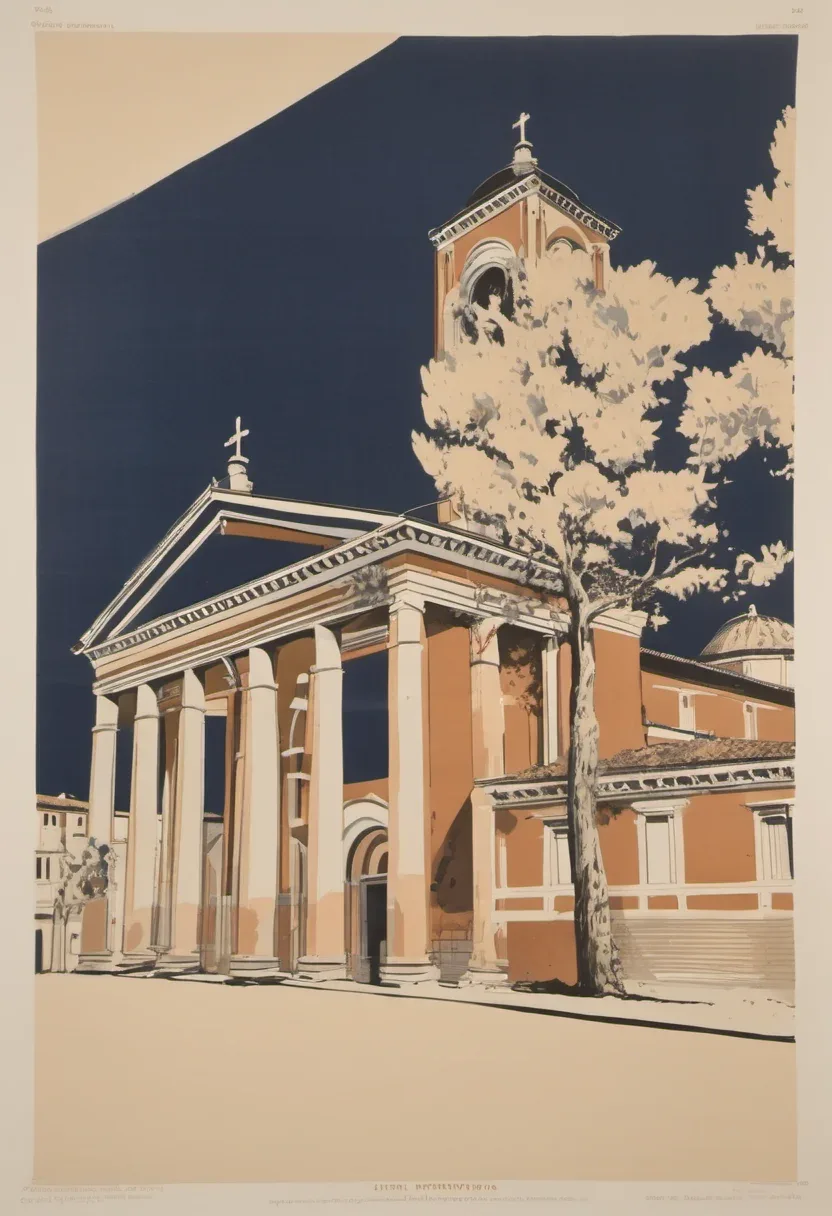
The Basilica di San Venanzio in Camerino is a monument of survival. Its facade alone displays a Romanesque portal, a Gothic rose window, and a Neoclassical pronaos—three eras in one glance. The church rose over the tomb of the city's patron saint, Venantius, and an ancient Roman cemetery. That site has been sacred for centuries, long before the current structure took shape.
Sacked in 1256 by Manfred's Swabian forces, the saint's relics were taken to Bari for nearly a decade. New walls erected in 1384 by Giovanni Varano finally enclosed the church. Reconstructions came in waves: the facade by Polidoro di Stefano, a Baroque dome in the 1670s by Bernardino Bianchini, and a full Neoclassical remake after the 1799 earthquake, led by Luigi Poletti, who planned a second bell-tower. The 2016 earthquake caused significant damage again.
Below, in the crypt, you find the saint's ark: a limestone sarcophagus decorated in the late 13th and early 14th centuries, supported by four black marble griffins. It is attributed to Tuscan artists. A silver statue commissioned by Bishop Francesco Vivani in 1764 stands nearby. Legends tell of the young martyr who survived fire, lions, and a fall from the city walls before beheading. His head, it is said, bounced three times and made water spring from the earth.
The Basilica di San Venanzio in Camerino does not reveal itself all at once. Stand in the piazza and you first notice the conflict of styles: a Romanesque portal with deep, concave arches; a Gothic rose window above; and a Neoclassical pronaos that seems to have arrived from another century. It is an exceedingly eclectic assembly, as the church has been rebuilt, restored, and reinvented many times.
A church has stood here since at least the 5th century, built over the tomb of Venantius, a Roman noble who became a Christian and was martyred at age sixteen under Emperor Decius. The site was once an ancient Roman cemetery. For centuries the building sat outside the early medieval walls, vulnerable. In 1256 the forces of King Manfred sacked the town, nearly destroying the church. The relics of Saint Venantius were stolen and taken to Bari; they did not return for almost ten years.
In 1384 Lord Giovanni Varano erected new walls, finally protecting the church. Over the following decades the faithful rebuilt. Documents from 1412 record payments for statues of Gabriel and the Virgin of the Annunciation. The facade was commissioned from Polidoro di Stefano of Perugia, and the tympanum was added in 1480. The portal remains a striking feature: concave, with receding arches flanked by pilasters and columns.
The interior evolved more slowly. A new crypt and a larger apse were built in the late 16th century, maintaining the Gothic layout, and some designs are attributed to Domenico Fontana. The choir was added in 1558. The dome, a Baroque addition, was designed by Bernardino Bianchini and completed between 1673 and 1677. Then came the earthquake of 1799. Much of the church fell, but the pieces were conserved, and reconstruction began under the architect Luigi Poletti. He gave the interior its current Latin-cross plan, with three naves separated by columns, a barrel vault in the central nave with stucco frames, and coffered ceilings over the aisles. He also planned a second bell-tower, though it was never built.
The 2016 earthquake struck hard, causing significant damage. The church is still healing, but it remains open. You can visit the crypt, where the ark of Saint Venantius rests on four black marble griffins. The sarcophagus, decorated in the late 13th and early 14th centuries, is thought to be the work of Tuscan artists. It stands on solomonic columns. Nearby, a silver statue of the saint, commissioned in 1764 by Bishop Francesco Vivani, gleams in the dim light.
The legends surrounding Venantius are vivid. A 15-year-old who refused the imperial edicts, he was scourged, smoked, burned, and stretched on a rack—yet came out unharmed, converting some of his torturers. Imprisoned and further tortured with hot coals, broken teeth, and a thrown into a cesspit, he still resisted. Lions were brought in, but they lay at his feet. Thrown from the city walls, he was found singing praises to God. Finally, he was beheaded. The head, it is said, bounced three times, and three springs of water gushed from the earth. This is why he is called 'acquaiolo,' the water carrier. In the town of San Venanzo, a similar legend holds that he struck a rock with his sword to water soldiers' horses, leaving a hoofprint in the stone.