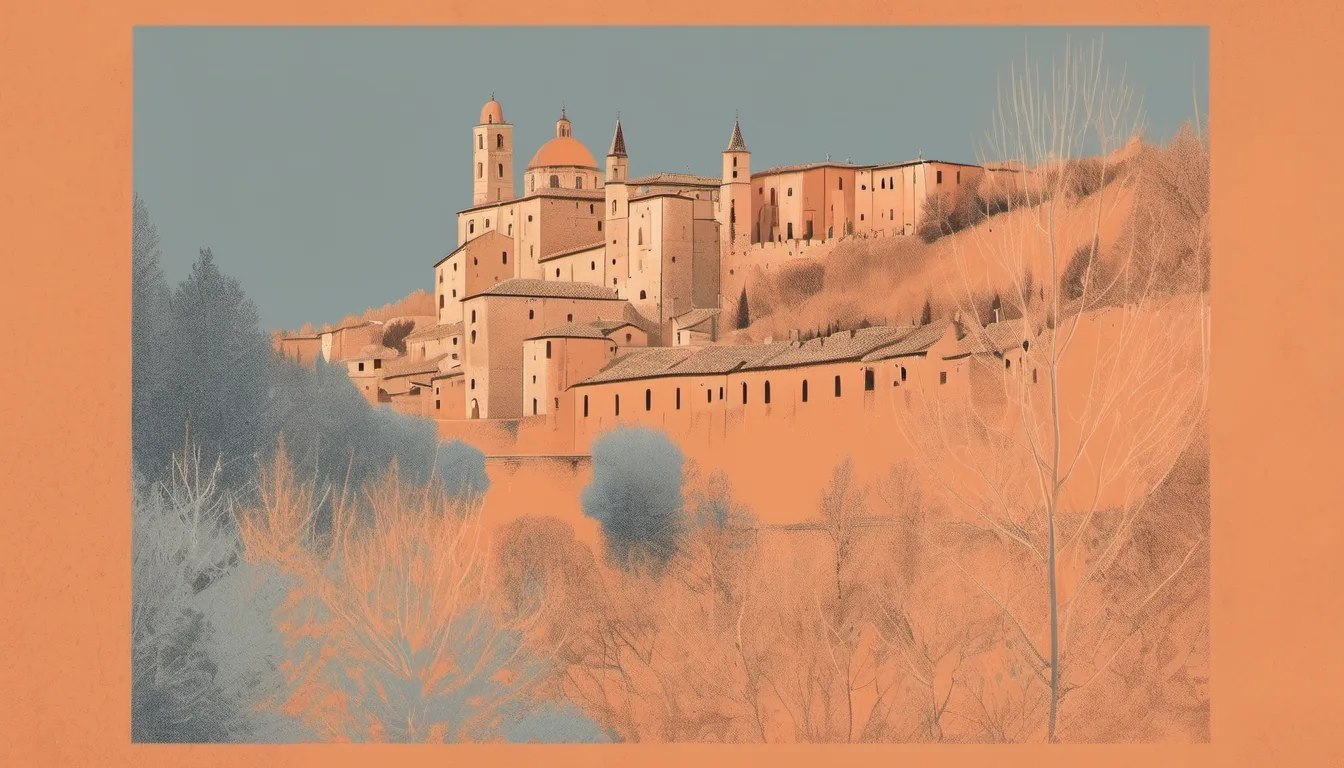
Urbino, Italy
Urbino does not announce itself with the clamor of Rome or the Venice of the north. It waits on a high, sloping hillside in the Marche, nestled against the Northern Apennines, where the air is thin and the stone is warm. To walk here is to move through a preserved moment of the Italian Renaissance, a time when art was not merely decoration but the very architecture of power. The town retains a picturesque medieval aspect, yet it is defined by a singular, brilliant era: the rule of Federico da Montefeltro, Duke from 1444 to 1482. This was not just a period of painting, but of reorganization, where the state was reshaped to be comfortable, efficient, and beautiful. You are walking through a city that was consciously designed to be a masterpiece of governance and aesthetics combined.
The heart of this experience is the Palazzo Ducale, rebuilt by the architect Luciano Laurana. It stands as the best-known architectural piece of the city, a geometric perfection that seems to float against the sky. But the palace is only the vessel. The true substance of Urbino lies in the court that filled it. Here, Piero della Francesca wrote on the science of perspective; Francesco di Giorgio Martini drafted his Treatise on Architecture; and Giovanni Santi, father of Raphael, chronicled the artists of the age. This was a court that set the standards for the modern European gentleman, as later described by Baldassare Castiglione in The Book of the Courtier. The city matters because it was a laboratory of humanism, where philosophy, art, and statecraft were indistinguishable.
Walking the narrow, winding streets rewards you with the tangible presence of this history. The University of Urbino, founded in 1506, continues this intellectual tradition, but the older layers remain visible in the stone. You will notice the seismic scars of the region—nearly 65 events between 1511 and 1998, including the strong shocks of 1741—yet the city stands firm. The architecture has absorbed these tremors, adapting and enduring. The view from the upper terraces offers a sweeping panorama of the surrounding hills, a reminder of the strategic importance this stronghold held during the Gothic Wars and the subsequent struggles between Guelphs and Ghibellines. It is a place where history is not archived but inhabited.
There is a quiet dignity to Urbino that resists the rush of modern tourism. It is a World Heritage Site for its remarkable historical legacy of independent Renaissance culture, but it feels less like a museum and more like a living conversation with the past. The city’s isolation, both geographical and intellectual, allowed its unique character to flourish. When you walk past the archbishop’s palace or the Chapel Albani, you are tracing the lines of patronage that stretched from the Montefeltro dukes to the Albani popes. The city’s singular quality is its integrity; it has not been fragmented by the chaotic growth of later centuries. It remains a coherent statement of what a Renaissance ideal city could be, preserving the balance of power, beauty, and intellect that Federico da Montefeltro envisioned.
Urbino sits on a high, sloping hillside in the Marche region, southwest of Pesaro, at the foothills of the Northern Apennines. It is a comune of modest size but immense historical weight, recognized by UNESCO as a World Heritage Site for its remarkable legacy of independent Renaissance culture. The town’s identity is inextricably linked to the Montefeltro family, who held power for centuries, and specifically to Federico da Montefeltro, Duke from 1444 to 1482. He was a condottiere, a diplomat, and a patron who reorganized the state according to a modern conception: comfortable, efficient, and beautiful. This was not merely an aesthetic choice but a political one, creating a court that became the center of European intellectual life.
The origins of Urbino are ancient, rooted in the Roman town of Urbinum Mataurense, named for the river Mataurus. During the Gothic Wars of the 6th century, it became a strategic stronghold, captured by the Byzantine general Belisarius in 538. The historian Procopius frequently mentions it, noting its importance in the conflict between the Ostrogoths and the Empire. After a period of Byzantine control, Pepin the Short presented Urbino to the Papacy in 754–56. However, papal dominance was largely formal for centuries. The commune retained a degree of independence, struggling between the influence of the Papacy and the Holy Roman Empire, until the House of Montefeltro gradually assumed control, first as podestà and eventually as hereditary lords.
The Montefeltro family’s rise was marked by the complex politics of the Guelphs and Ghibellines. In the 13th and 14th centuries, the Montefeltro lords were leaders of the Ghibellines in the Marche and Romagna. Guido da Montefeltro, a key figure, was vicario regio and supported the Hohenstaufen emperors. His conflicts with the Papacy led to his exile in 1285, but the family’s grip on Urbino remained resilient. They navigated the turbulent waters of Italian factionalism, occasionally losing control to Rimini or papal forces, but always regaining it. By the time Federico da Montefeltro rose to power in 1444, following the murder of his brother Oddantonio, the family had established a dynasty that would define the city’s golden age.
Federico’s court was a beacon of humanism. He invited some of the greatest minds of the era to his capital. Piero della Francesca resided here, writing on the science of perspective, which would revolutionize art. Francesco di Giorgio Martini wrote his Trattato di architettura, influencing urban planning. Giovanni Santi, father of Raphael, wrote a poetical account of the chief artists of his time. This was a community of thinkers and creators. Baldassare Castiglione, who later served at this court, described it in Il Cortegiano (The Book of the Courtier, 1528) as the model for the modern European gentleman. The court set standards of behavior, art, and intellect that would influence Europe for centuries.
The architectural jewel of this era is the Palazzo Ducale, rebuilt by Luciano Laurana. It is Urbino’s best-known architectural piece, a masterpiece of Renaissance architecture that harmonizes with the hillside. The palace was not just a residence but a symbol of the Duke’s power and taste. It housed a library that became one of the most important in Europe, later absorbed by the Vatican Library in 1657. The palace’s design reflects the intellectual rigor of the time, with precise proportions and a serene elegance that mirrors the philosophical inquiries of its inhabitants. Walking through its courtyards is to walk through the mind of the Renaissance.
The Montefeltro dynasty ended in 1508 with the death of Guidobaldo. Cesare Borgia, with the complicity of his father Pope Alexander VI, dispossessed Guidobaldo and his wife Elisabetta Gonzaga in 1502. This marked the beginning of a decline. Urbino became part of the Papal States, ruled by the Della Rovere dynasty from 1508 to 1631. The court was moved to Pesaro in 1523, and Urbino entered a slow decline. The rich artistic heritage of the Ducal Palace, including furniture and artworks, was largely dispersed. Many works went to form the dowry of Vittoria della Rovere, who married Ferdinand II de Medici, eventually forming the core of the Uffizi Gallery in Florence. The diptych of the Dukes of Urbino by Piero della Francesca is among those now in Florence.
In 1626, Pope Urban VIII definitively incorporated the Duchy into the papal dominions. The last Della Rovere duke, in retirement after the assassination of his heir, gifted the state to be governed by the archbishop. It was ruled thereafter by a papal legate. The 18th century brought a brief resurgence with the election of Cardinal Giovan Francesco Albani as Pope Clement XI in 1701. His patronage funded major renovations, including Palazzo Albani, the town hall, and the archbishop’s palace. The city also hosted the court of James Stuart, the exiled pretender to the British throne, from 1717 to 1718, supported by the papacy. This period saw significant artistic and cultural investment, but after Clement XI’s death in 1721, decline resumed.
The 19th century brought urban redevelopment. The new Duomo di Urbino was consecrated in 1809, designed by Giuseppe Valadier, who also restored Montefeltro-era buildings. The construction of the New Palace of Alban in 1831, designed by Peter Ghinelli, created Piazza della Repubblica and the beginning of Corso Garibaldi. The Sanzio theater (1845–53) completed the Corso, with a covered walkway to shelter theater-goers. In 1868, part of the city walls were destroyed to create Porta Nuova, a customs barrier named for Princess Margaret of Savoy. This opened easier access to the city center, altering the urban layout and incorporating the Pincio, a spit of land below the Doge’s Palace.
The Unification of Italy saw Piedmontese troops enter Urbino on 8 September 1860, forcing the surrender of the papal army. A plebiscite in November 1860 annexed the Marche to the Kingdom of Sardinia with overwhelming support. Despite these political changes, Urbino retained its artistic heritage. The city is remembered in the series of sculptures at the Vittoriano, dedicated to the fourteen noble cities of united Italy. Its center, designated a UNESCO World Heritage Site in 1998, preserves the architectural legacy of the Renaissance. The University of Urbino, founded in 1506, continues to be a seat of learning, and the city remains the seat of the Archbishop of Urbino.
Geographically, Urbino is in a medium-high seismic risk area. Nearly 65 seismic events have affected the town between 1511 and 1998. Notable shocks include the 1741 event, stronger than VIII on the Mercalli scale, with an epicenter in Fabriano, and the 1781 collapse of the cathedral dome. These events have shaped the city’s architecture, requiring constant maintenance and adaptation. Yet, the city stands resilient. The high sloping hillside offers panoramic views of the surrounding countryside, a reminder of its strategic importance. Walking Urbino is to walk through layers of history, from Roman origins to Renaissance glory, through papal rule and unification, all preserved in stone and silence. It is a city that rewards the slow, attentive walker with the profound beauty of a realized ideal.
Do not miss around Urbino
4 placesEvery place below is a ten-to-fifteen minute walk from the last.