San Colombano — Collezione Tagliavini
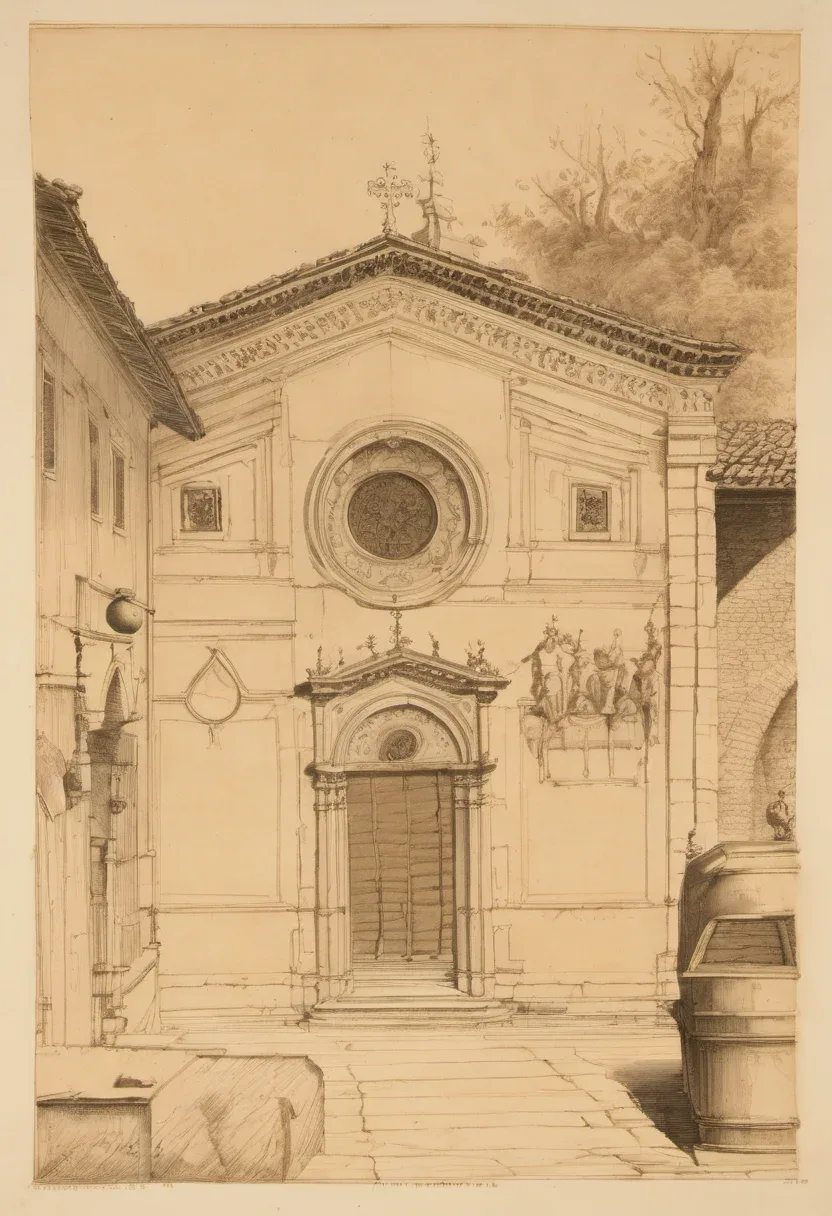
Ninety-odd harpsichords surround you here, arranged like an orchestra that never plays together. Above them, a vaulted ceiling frescoed by a Guido Reni who hadn't yet turned twenty-five. This deconsecrated church near Bologna's old northern gate has been a monastery, a parish, and, for two centuries under the Republic of Lucca, student lodgings. Since 2010 it has been something better: a working museum of keyboard instruments, most of them still able to play.
The man behind it was Luigi Ferdinando Tagliavini, a Bolognese organist and scholar who spent his career rediscovering how Baroque music actually sounded. He bought his first instrument, a sixteenth-century spinet, in 1969. Four decades later he had assembled one of Europe's significant private collections of early keyboards, harpsichords, clavichords, early pianos, spinets, even a few mechanical instruments, and gave the whole thing to his home city.
Look up before you look at the instruments. The ceiling's Passion cycle, painted around 1600, pitted a young Reni against fellow apprentices Domenichino and Francesco Albani, in what the Bolognese historian Malvasia later called the glorious competition. Then look down: beneath the floor sits a Roman-era crypt, uncovered only in 2007, holding a crucifixion fresco attributed to Giunta Pisano, a painter working a full generation before Giotto.
Seek out the 1679 harpsichord by Giovanni Battista Giusti of Lucca, three registers deep and restored to full voice. It is the collection's anchor piece. Come at the right moment and you might hear one played. These are not relics under glass. They are instruments, waiting for hands.
Look at the ceiling first, not the instruments. That Passion cycle above you, Christ arrested, scourged, risen, was painted around 1600 by a handful of young men barely out of their apprenticeships. One of them was Guido Reni, not yet twenty-five and not yet famous. Another was Domenichino. A third, Francesco Albani. They were students of the Carracci academy, set loose here in friendly rivalry, and the result was good enough that the Bolognese art historian Carlo Cesare Malvasia, writing decades later, called it simply the glorious competition.
You're standing in a building that has changed jobs more often than most. Bishop Pietro I founded a church here around 616, on top of what was likely a late-Roman structure. Benedictine monks from the Swiss abbey of St Gall are documented running the place by 1008; nuns took over in 1144, then Carmelites and Poor Clares. In 1304 the monastery itself was suppressed after internal disputes, though the church stayed open for worship. In 1679 ownership passed to the Republic of Lucca, which used the complex to house its students abroad, and added the portico you may have walked under to get here. By 1798, Napoleonic reforms had deconsecrated it for good.
For two centuries after that, San Colombano drifted. It took the Fondazione Cassa di Risparmio in Bologna, which bought the complex in 2005, to give it a second life. The restoration, led by architects Roberto Scannavini and Francisco Giordano, turned up something nobody expected: a late-Roman crypt beneath the apse, sealed for centuries, along with a thirteenth-century burial and a crucifixion fresco, Christ between the Virgin and Saint John, attributed to Giunta Pisano, a painter working a full generation before Giotto. The complex reopened in 2010, and this time it had a new tenant waiting: a collection of nearly ninety keyboard instruments.
That collection has a single author: Luigi Ferdinando Tagliavini, born in Bologna in 1929, dead here in 2017. He trained as an organist under Marcel Dupré in Paris, wrote his university thesis at Padua on the texts Bach chose for his sacred cantatas, and spent the back half of his career as professor of musicology at the University of Fribourg in Switzerland. Alongside Gustav Leonhardt and Marie-Claire Alain, he belonged to the generation that rebuilt, almost from scratch, how Baroque organ and harpsichord music was understood to actually sound.
His collecting began small and specific: a sixteenth-century spinet, bought in Bologna in 1969, simply because he found it. It kept growing for four decades. The centerpiece is a three-register harpsichord built in 1679 by Giovanni Battista Giusti of Lucca, coincidentally the same city that once owned this church. There is a 1685 harpsichord by Mattia De Gand, a Flemish maker who had settled in Rome; a spinet attributed to Alessandro Trasuntino from around 1540; and a 1746 instrument by Giovanni Ferrini that combines a harpsichord and an early piano in a single case, built at exactly the hinge point when one technology was replacing the other. One spinet, the story goes, once belonged to the Cenci-Bolognetti family, kin to the Beatrice Cenci executed in Rome in 1599 for killing her abusive father. Whether she ever touched the keys herself is impossible to say.
What makes the place work is that almost none of it is silent. Tagliavini restored his instruments to playing condition, not museum condition, and most still are, struck, plucked or bowed the way they were built to be. Beside the instruments sits the Oscar Mischiati Library, some fifteen thousand items on organs and early music, donated by Tagliavini's closest friend and fellow scholar. Between the crypt below, the frescoes above, and the ninety-odd instruments in between, San Colombano ended up holding three separate centuries of Bolognese ambition under one unassuming roof, and gave every one of them a second act.