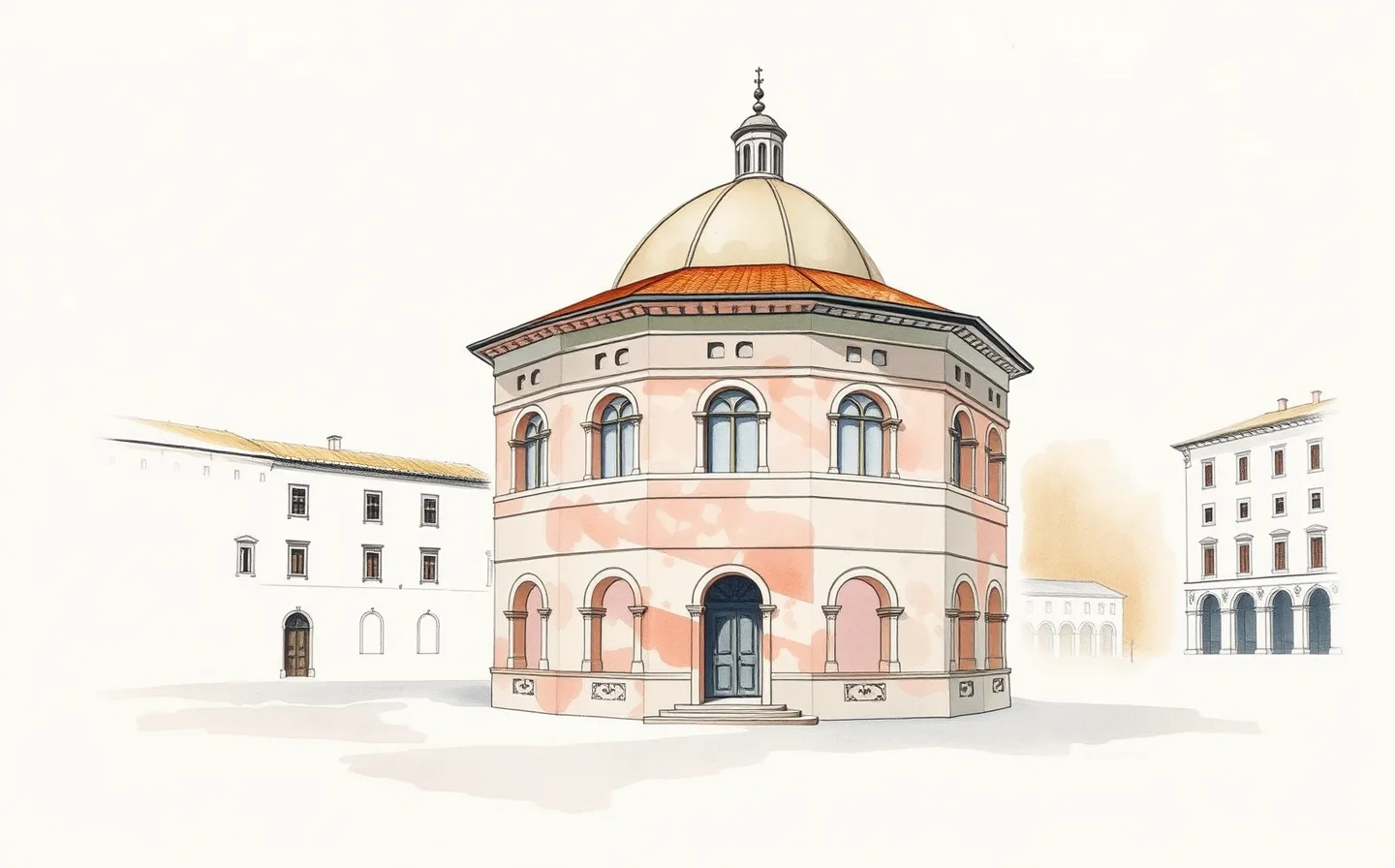
The Ducal Palace: a Baroque masterpiece of the Farnese era.
Parma, Italy
Parma does not shout. It hums with the low, steady frequency of a city that has survived empires, sieges, and the quiet erosion of time. Divided by the Parma stream, the west side—Oltretorrente—holds the rebellious heart, while the east preserves the architectural dignity of the Farnese duchy. To walk here is to move through layers of Roman stone, medieval brick, and Baroque ambition, all under a sky that has watched it all.
The city’s significance lies not in monumental scale, but in its dense concentration of cultural gravity. It is the home of the University, one of the oldest in the world, and the birthplace of a culinary identity that defines Italy abroad. The air smells of curing ham and aged cheese, a scent that clings to the narrow streets of the Jewish quarter and the bustling markets of the center. This is a place where food is politics, and politics is art.
Walking Parma rewards the observer with details often missed by the hurried tourist. The Palatine Library holds Hebrew manuscripts second only to Oxford’s. The Duomo’s bell tower, the Ghirlandina, stands as a testament to medieval rivalry with Modena. But the true reward is the rhythm of daily life: the clatter of cutlery in trattorias that have served the same recipes since the 18th century, and the quiet dignity of the Ducal Palace, where the Farnese family once ruled with an iron fist and a patron’s eye. It is a city that asks you to slow down, to taste, and to listen.
Parma’s story is written in the strata of its architecture and the blood of its rulers. Founded as a Roman colony in 183 BC, it served as a crucial hub on the Via Aemilia. Its name, derived from the Etruscan 'parma' or round shield, hints at its defensive origins. The city was sacked by Attila in 452, destroyed by Totila during the Gothic War, and later renamed Chrysopolis, or 'Golden City,' under Byzantine rule, likely due to its imperial treasury. These layers of conquest and reconstruction are visible in the stone itself, from the Roman forum site at Garibaldi Square to the medieval fortifications.
The Middle Ages saw Parma emerge as a powerful commune, often aligned with the Holy Roman Empire against the Papacy. Two of its bishops became antipopes: Càdalo (Honorius II) and Guibert (Clement III). The city’s strategic importance was cemented by its position on the Via Francigena, the pilgrim route to Rome. Castles, hospitals, and inns sprang up to serve the steady flow of travelers crossing the Apennines. A vibrant Jewish community established itself here, leaving behind the Palatine Library, which today houses the largest collection of Hebrew manuscripts in Italy.
The 16th century brought the Farnese dynasty, transforming Parma into a cultural powerhouse. Pope Paul III, Alessandro Farnese, granted the duchy to his illegitimate son, Pier Luigi, in 1545. The Farnese rulers, particularly Rannuccio I and his successors, invested heavily in art and architecture. The Ducal Palace, designed by Simone Mosca and Giovanni Battista Antonelli, became a symbol of their power. The city attracted scholars, artists, and musicians, establishing a reputation that would endure for centuries. The University was enhanced, and the Jesuit college became a center of scientific inquiry.
The 18th century marked Parma’s Enlightenment peak under Prime Minister Guillaume du Tillot. He modernized the state, founded the Palatine Library, the Archaeological Museum, and the Picture Gallery. The Royal Printing Works, directed by Giambattista Bodoni, produced some of the most beautiful typefaces in history. This era of splendor was interrupted by the Napoleonic Wars, when Parma was annexed to France. After the Congress of Vienna in 1815, the Duchy was restored to the House of Bourbon-Parma, but the spirit of the Enlightenment remained embedded in the city’s institutions.
Today, Parma is known globally for its culinary exports: prosciutto and Parmigiano Reggiano. But the city’s essence is found in its daily life. The Oltretorrente district, west of the stream, retains a bohemian, student-driven energy, contrasting with the formal elegance of the city center. The narrow streets are lined with trattorias, bakeries, and artisan shops. The annual truffle fairs in autumn draw collectors from around the world, but the true flavor of Parma is found in the quiet moments: a morning espresso at a historic café, a walk along the Parma stream, or a visit to the Teatro Regio, one of Italy’s premier opera houses. It is a city that balances its rich history with a vibrant, contemporary pulse.
Do not miss — Parma
Every place below is a ten-to-fifteen minute walk from the last.