Studiolo of Federico da Montefeltro
Every cupboard in this room is a lie. Shelves stacked with books, a suit of armor, a songbird locked in its cage — none of it is real. It's wood, sliced paper-thin and fitted together so precisely that a flat wall becomes a three-dimensional trick played on your eyes.
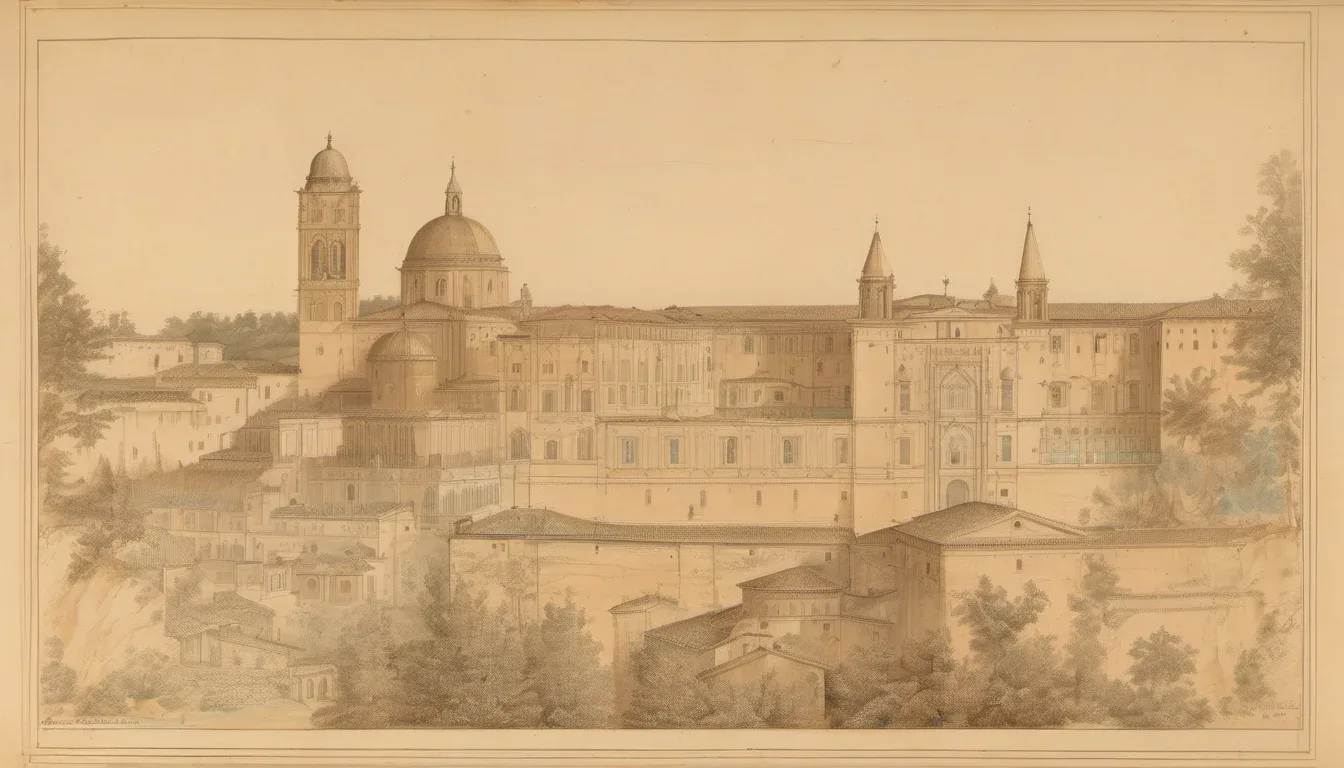
Federico da Montefeltro, mercenary captain turned Duke of Urbino, had this study finished by 1476 — his innermost room, where the soldier put down his sword for a book. Barely three and a half metres square, it sits high in the palace between two slender towers, its one real window turned away from the town and out toward open country. This was privacy, not performance.
Every inlaid object argues for the kind of man Federico wanted to be remembered as. Astrolabes, an hourglass, a lute, his own armor cast carelessly in a corner — a life of war translated into decades of humanist learning, worked in forty different woods by hands steady enough to fool a Renaissance eye. Above it all, painted scholars from Plato to Dante watch over him, as if certifying his membership in their club.
Nobody can say for certain who designed the scheme — Piero della Francesca, Francesco di Giorgio Martini and Bramante have all been suggested, and the argument has run for over a century. What's fairly settled is who built it: Benedetto da Maiano's workshop, cutting wood to the fraction of a millimetre.
Find the squirrel gnawing a nut beside a painted lattice door, and the bird trapped in its illusionary cage. A private joke, tucked into the most obsessive perspective trick of the Renaissance — and proof that even here, in a room built from illusion, the smallest details had to be true to life.
Look at the wall to your left. That cupboard door, hanging half open on a wooden hinge, revealing a shelf of books and a candle burning low, isn't separate from the wall at all. It's flat. Every shadow, every fold of cloth, every glint of light on an astrolabe is built from thousands of slivers of wood, so precisely cut and shaded that your eye insists on a depth that simply isn't there.
This is the studiolo of Federico da Montefeltro, finished in 1476, and it may be the single most obsessive room the Italian Renaissance produced. Barely three and a half metres to a side, smaller than most hotel rooms, it sits at the summit of the Ducal Palace, wedged between the two slim towers that still define Urbino's skyline from any road into town. Its one true window looks away from the city Federico ruled, out over the hills he owned. He built himself a room with a view of his own land, not his own subjects.
Federico earned the money for all this the hard way. He was a condottiero, a mercenary general who sold his army, and himself, to whichever pope or prince paid best, including a lucrative contract with Naples and steady work for Rome. War financed peace: the fortune from the battlefield paid for one of the most sophisticated courts in Italy, stocked with an enormous library and a circle of humanist scholars. This room is where that transformation from soldier to sage gets staged, quite literally, in wood.
Look closer and you'll find his own armor, discarded in a corner as if he'd just shrugged it off to sit and read. Around it: a lute, a clavichord, an hourglass, books with their spines just slightly ajar, the tools of the quadrivium, the medieval curriculum of arithmetic, geometry, music and astronomy. Above the wood, a separate register once held twenty-eight painted portraits looking down on him: Plato, Aristotle, Dante, Petrarch, Moses, even Federico's own tutor placed shoulder to shoulder with Euclid. Only fourteen remain in Urbino. The rest were seized by a cardinal in the 1630s, sold twice over the following two centuries, and bought for the Louvre by Napoleon III in 1861, half of Federico's gallery of genius now hanging permanently in Paris.
Who actually designed the perspective scheme is one of the enduring arguments of Renaissance scholarship. Piero della Francesca, who painted Federico's famous hook-nosed profile now in the Uffizi, is one candidate. So are the architect Francesco di Giorgio Martini and, more speculatively, a young Bramante. Nobody has settled it, and probably nobody ever will. What is agreed is the hand that executed it: Benedetto da Maiano and his workshop, inlaying more than forty species of wood, tinted with natural dyes and scorched sand to fake shadow and highlight.
Federico had an almost identical fantasy built at his other residence, in Gubbio, a few years later. That room didn't survive intact; its panels were stripped out in the nineteenth century, sold on, and eventually shipped to New York, where the Metropolitan Museum of Art reassembled them between 1939 and 1941. Urbino's studiolo is the only one of the pair still in the room it was designed for, which is part of why standing inside it means something more than admiring a museum case.
Find the squirrel gnawing a nut on a painted ledge, and the caged bird glimpsed through a half-open lattice door near the real door onto the balcony — guides here like to say first-time visitors have reached out to touch a door that isn't there. It's a private joke buried in the middle of the most rigorous perspective exercise of the century.
The room reopened in 2025 after conservators spent two years in the archives and seven months treating the wood against centuries of insects and damp. Stand here a moment longer. A man who spent his life on other people's battlefields built the smallest, quietest room imaginable, and filled every inch of it with an argument for who he really was.