Arian Baptistery
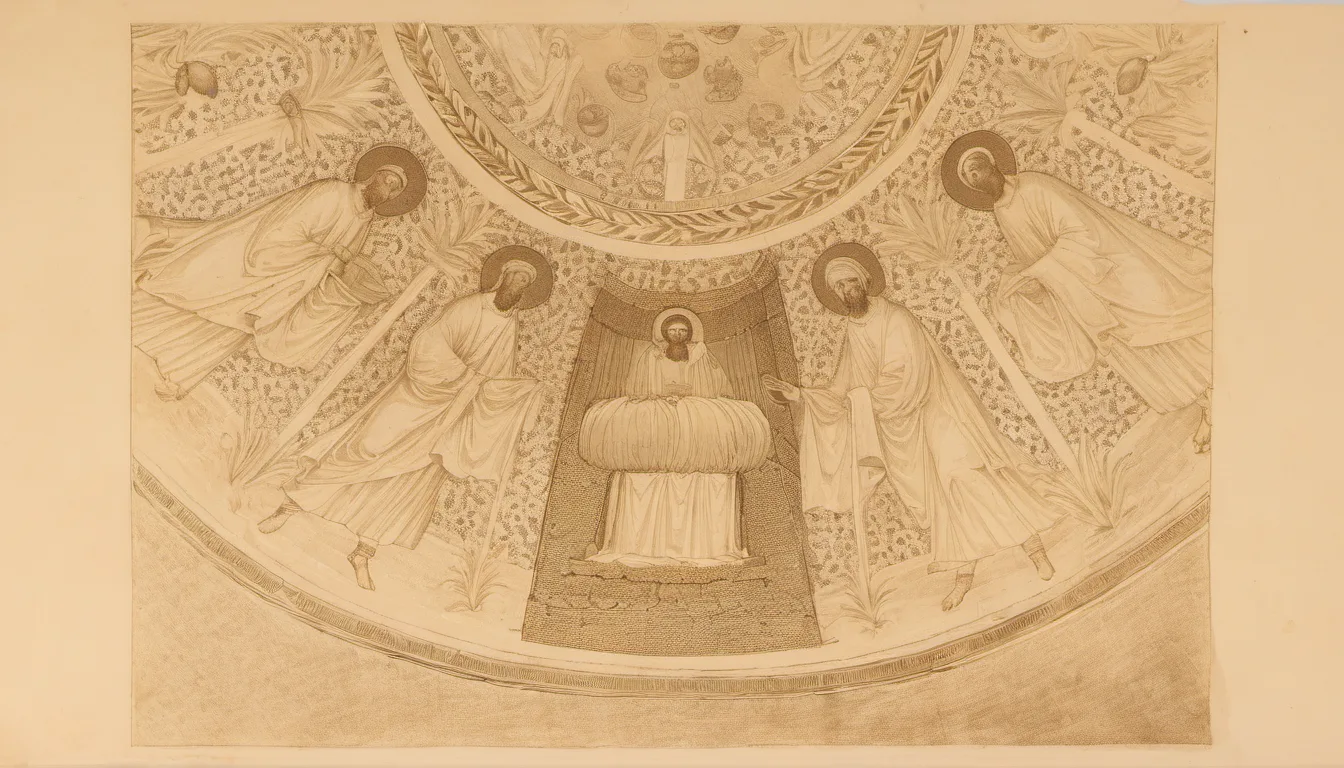
Look up. That gold dome is the last of its kind on Earth — the only surviving baptistery built for a version of Christianity Rome eventually crushed. Circling the rim, twelve saints process toward a jeweled, empty throne. At the center, Christ stands waist-deep in the Jordan, beardless, water closing gently over him.
Theodoric the Great raised this around the year 500. An Ostrogothic king ruling Italy from right here in Ravenna, he was also an Arian Christian — a faith that held Christ was made, not eternal, and lesser than God the Father. Orthodox Rome called that heresy. Theodoric built his own cathedral anyway, and this small brick octagon beside it, so his people could be baptized in a church of their own.
It didn't last. Byzantine troops retook Ravenna in 540, and within a generation the dome was reconsecrated to Catholic worship and renamed for the Virgin. Every other Arian church like it, across the old Ostrogothic kingdom, vanished or was scraped clean. This one wasn't. The heresy is still legible overhead, gold on gold, thirteen centuries on.
One more thing: you are standing about two metres below Theodoric's Ravenna. The city's ground has crept upward for fifteen hundred years, swallowing its own history in silt. The baptistery never sank. The world around it simply kept rising — and left this dome exactly where it always was.
Look up at that dome for a second. Christ stands waist-deep in the River Jordan, young and beardless, water closing over his shoulders while John the Baptist — dressed, oddly, in a leopard skin — reaches to touch his head. Above them, a dove. Around the rim, twelve robed figures process toward an empty, bejeweled throne, each one veiling his hands to carry a crown. That's the entire decorative program of this building. Every wall below is bare brick. All the wealth went up, into the gold.
The man who commissioned this was Theodoric the Great, an Ostrogothic king who took Italy in 493 and ruled it from Ravenna for over three decades. He was also an Arian Christian — a follower of a fourth-century teaching, condemned as heresy at the Council of Nicaea in 325, that held Christ was created by God the Father rather than co-eternal with him. Most of his Gothic soldiers and courtiers shared that faith; Ravenna's existing population, largely Orthodox, did not. Rather than force the issue, Theodoric built parallel institutions — his own cathedral, now the church of Santo Spirito, and beside it, this small octagonal baptistery, raised around the year 500.
It was, pointedly, a rival to the Neonian Baptistery nearby — the orthodox community's own domed baptistery, built decades earlier under Bishop Neon. Theodoric's copies its basic scheme almost detail for detail: octagon, dome, gold mosaic of Christ's baptism. Whether that's homage or provocation is debatable. Either way, it says something about a king secure enough to build his heretical faith a monument in full view of the church that had damned it.
The politics didn't hold. Theodoric died in 526, and in 540 a Byzantine army under Justinian retook Ravenna and ended Ostrogothic rule in Italy for good. Arianism went with it. Within a generation or two, this building was reconsecrated for Catholic worship and renamed Santa Maria in Cosmedin. Across the former Ostrogothic kingdom, most Arian churches were destroyed, rebuilt beyond recognition, or simply abandoned. This one wasn't. It kept its congregation, changed its theology, and left its ceiling untouched — which is why it survives today as the only Arian baptistery known to exist anywhere in the world.
Some historians read theology into the mosaic itself. Look closely and Christ faces east rather than west, the reverse of the orthodox convention at the Neonian Baptistery; the dove's beak appears to touch the crown of his head rather than simply hover above it. A few scholars argue these are deliberate signals of Arian doctrine, coded into gold tesserae where a hostile bishop couldn't easily object. Others think it's simply a different workshop's habit. Nobody has settled it, and probably nobody will.
Notice, too, that you're standing roughly two metres below the pavement outside. That's not a design choice. Ravenna's ground level has risen steadily for fifteen centuries, buried under silt from the rivers and lagoons that once made this a great Adriatic port. Every Late Antique building in the city has sunk the same way; this one just shows it more starkly, since visitors descend a short staircase to a floor that once stood level with the surrounding street.
One puzzle nobody has fully explained: excavators found six graves inside this building, dug into the floor of what was, at least originally, a baptistery rather than a burial church. They likely date from its centuries as a working oratory, when the dead of a small parish congregation might reasonably be laid near the altar. But nobody recorded who they were, and the baptistery has never given up the names.
Stand here long enough and the gold above you starts to feel less like decoration than argument — a king's answer, in tesserae, to a theological quarrel that split an empire. The empire that made the argument is long gone. The dome, somehow, is still speaking.