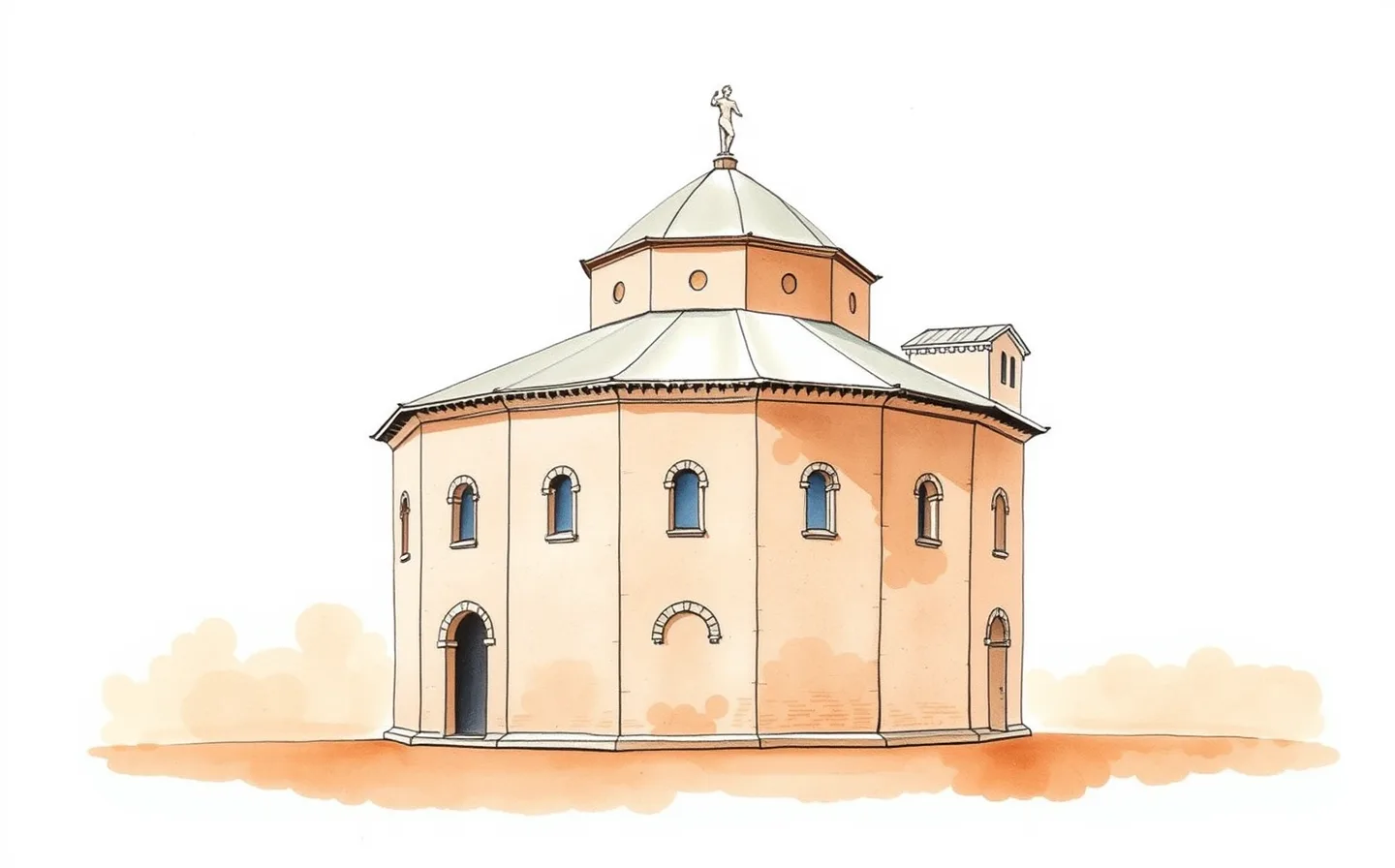
San Vitale's dome glows in the Adriatic light
Ravenna, Italy
Ravenna is not a city that shouts. It sits quietly in the Emilia-Romagna plain, a coastal town where the Adriatic meets the land, and where history has been preserved not in stone alone, but in light. It is a place of hushed reverence, where the air feels thicker with the weight of centuries, and where the modern world seems to pause at the edge of the marshes.
The city’s value lies in its sixth-century mosaics, some of the most intact and brilliant in the world. These are not mere decorations; they are theological statements rendered in glass and gold, covering walls and vaults in churches that have stood since the fall of Rome. To walk Ravenna is to walk through a luminous manuscript of early Christianity, where every tessera tells a story of faith, power, and artistry.
Walking here rewards the observer with a sense of timelessness. The streets are wide and empty, the light is soft and diffused by the sea breeze, and the monuments stand in quiet dignity. You do not rush through Ravenna; you let it unfold. The city asks for your attention, offering a rare chance to see the past not as a relic, but as a living, breathing presence in the present.
Ravenna’s significance begins with its geography. Located in the Emilia-Romagna region, it sits where the Po River delta meets the Adriatic Sea. Historically, this was a strategic port, but by the fifth century, swamps had made it inaccessible to ships. This isolation, however, became its salvation. When the Western Roman Empire fell, Ravenna became the capital of the Ostrogothic Kingdom under Theodoric the Great, and later the seat of the Byzantine Exarchate. It was here, far from the chaos of Italy, that the last emperors of Rome sought refuge and patronage.
The monuments that define Ravenna today were built during this brief but intense period of Byzantine influence, primarily in the sixth century. The most famous are the Mausoleum of Galla Placidia, the Basilica of San Vitale, and the Neonian Baptistery. These structures are not merely religious sites; they are political manifestos. Theodoric and his successors used art to assert their legitimacy, blending Roman, Christian, and Gothic traditions into a new visual language. The mosaics, with their deep blues and golds, were designed to dazzle and to instruct, turning the interior of the churches into visions of heaven.
San Vitale, completed around 547 AD, is the crown jewel. Its octagonal plan and central dome create a sense of dynamic movement, while the mosaics depict Emperor Justinian and Empress Theodora with their retinues. The figures are stylized, floating in a golden space that denies earthly gravity. This is not realistic portraiture; it is symbolic. The rulers are shown not as men, but as agents of divine order. The precision of the work is staggering, with millions of tiny glass cubes, some with gold leaf sandwiched between, creating a shimmering effect that changes with the light.
The Mausoleum of Galla Placidia, though smaller, is no less profound. Named after the daughter of Emperor Theodosius I, it houses some of the earliest and most sophisticated mosaics in Ravenna. The starry sky in the crossing, with its deep blue background and golden crosses, is a masterpiece of early Christian art. The figures of the apostles are depicted with a solemnity and simplicity that contrasts with the opulence of San Vitale. Here, the focus is on salvation and eternity, not imperial power.
Walking through Ravenna today, you can still feel the weight of this history. The city is small, compact, and easy to navigate on foot. The streets are lined with trees, and the light is often soft, especially in the early morning or late afternoon. The monuments are not crowded with tourists in the same way as Rome or Florence; they retain a sense of intimacy and quiet. You can stand in the center of San Vitale and feel the silence, broken only by the occasional church bell or the distant sound of the sea.
Locals know that the best way to experience Ravenna is to visit the monuments at different times of day. The light changes the appearance of the mosaics, revealing details that are hidden in the harsh midday sun. The Neonian Baptistery, with its circular plan and complex iconography, is particularly striking in the evening, when the golden light fades and the figures seem to emerge from the darkness. It is a reminder that these mosaics were designed to be experienced, not just seen.
Ravenna is also a city of water. The surrounding marshes, once a barrier, are now a protected nature reserve. The city’s relationship with the sea is complex, marked by centuries of struggle against flooding and erosion. This history is visible in the landscape, where the land meets the water in a delicate balance. To walk along the coast, past the lighthouses and the dunes, is to understand why Ravenna was once a vital port, and why its isolation allowed it to preserve its artistic heritage. It is a city that has survived by adapting, by finding strength in its quietness.
Do not miss — Ravenna
Every place below is a ten-to-fifteen minute walk from the last.