Neonian (Orthodox) Baptistery
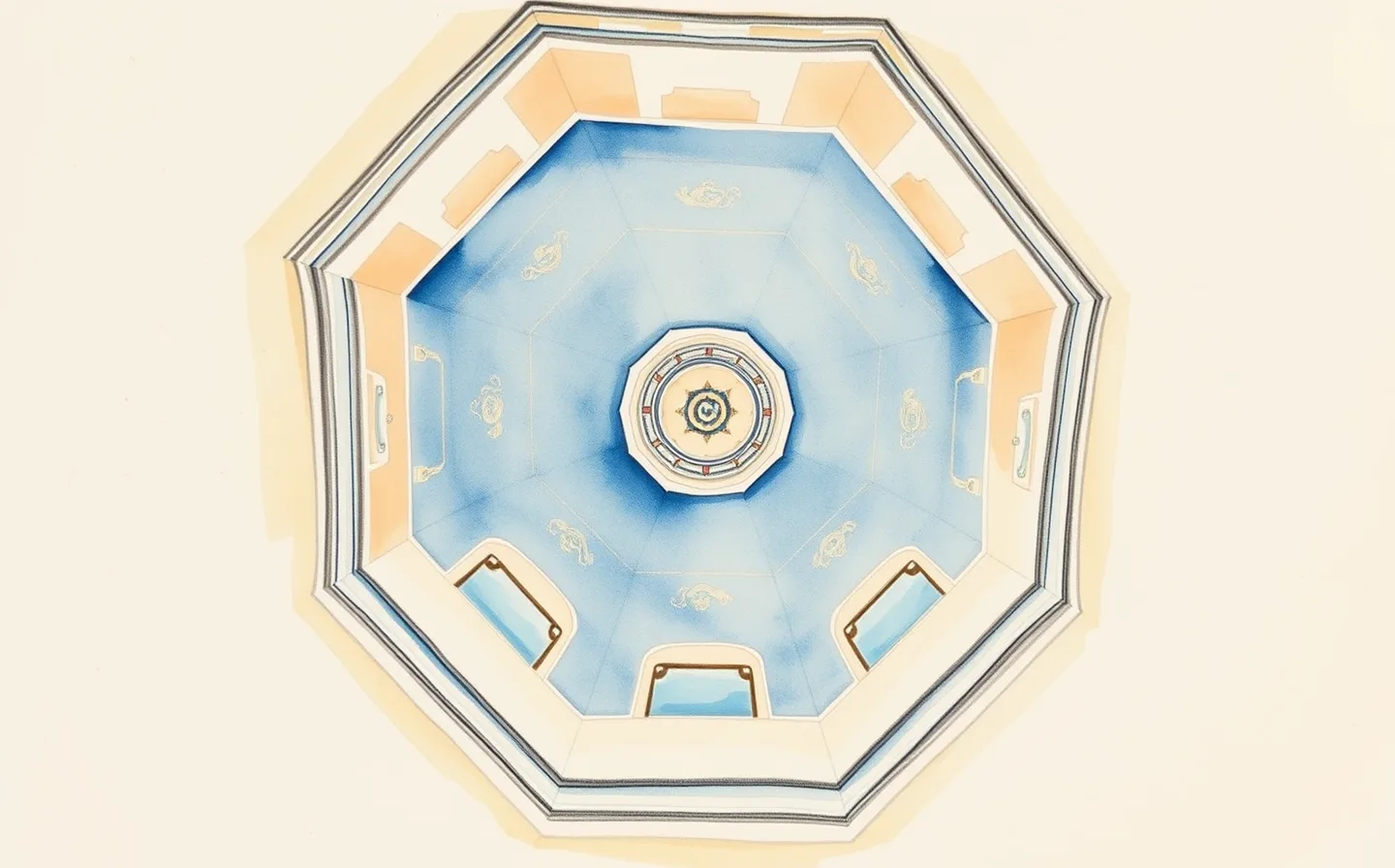
Look straight up. That gold dome holds the oldest surviving mosaic image of Christ's baptism anywhere on earth, laid down around the year 450 — nothing else this old, on this subject, survives intact.
This room started as a Roman bathhouse. Around the year 400, Ravenna's bishop, Ursus, converted it into a baptistery, right as the city became capital of what remained of the Western Roman Empire — money and ambition to match. Fifty years later, Bishop Neon tore off the roof and commissioned everything you see overhead, the dome mosaic and the marble sheathing on the walls below it. His name stuck to the building ever since.
Around the rim, twelve apostles in white process toward the center, where Christ stands waist-deep in the Jordan while John the Baptist pours water over his head, from a jeweled dish, on what looks like a bejeweled scepter. Except that dish is almost certainly fake. A restorer named Felice Kibel reworked this exact scene in the 1860s, and scholars still argue about how much he invented outright. Look closely at the heads of Christ and John: the glass tesserae shift colour, faintly, right where his brush stopped. The original John may have simply rested his hand on Christ's head, the way the same scene plays out in Ravenna's other, rival baptistery a few streets away.
Sixteen centuries on, this is still the most complete Early Christian baptistery standing anywhere — brick, marble, stucco and mosaic, all original enough to matter, all still in the room they were built for. Nothing here is a replica.
Look up at the dome for a moment, and follow the gold spiral of tesserae to its center. There: a man standing waist-deep in a river, naked, while another man beside him pours water over his head from a shallow dish. That is Christ's baptism, and this is the oldest surviving mosaic version of that scene anywhere on earth. Nothing else from the fifth century comes close.
You are standing inside what began as a Roman bathhouse. Around the year 400, Ravenna's bishop, a man named Ursus, took over the site — the city had just become capital of what remained of the Western Roman Empire, with an imperial budget behind it. Ursus raised the octagonal brick shell around you; it took another fifty years, and another bishop, to finish the job. Neon — the name that has stuck to this building ever since — tore off the original roof around 450 and commissioned the dome mosaic, the marble sheathing on the walls, and the stucco prophets that once ringed the room beneath the windows.
Why octagonal? Early Christian writers had an answer ready: seven days of creation, plus an eighth, standing for the resurrection, outside ordinary time. Whether that's really why Neon's builders chose the shape, or simply the fashionable form for a converted Roman bath, nobody can say for certain. What is certain is that the building needed a name to distinguish it from a rival raised two generations later by the Ostrogothic king Theodoric, for an Arian church that denied Christ's full divinity. That building borrowed this one's composition and simplified it for a different theology — comparing the two today is like reading the same paragraph rewritten by an opponent.
Look at the middle band of the dome: twelve men in white robes, carrying jeweled crowns, walking in two files that meet where Peter and Paul greet each other. Below them, eight garden scenes alternate with eight empty thrones, a motif called the Etimasia — a throne prepared for Christ's return, cross and open gospel already resting on the seat. At the center, Christ stands in water built from glass tesserae tilted at slightly different angles, so the surface seems to shift as you move beneath it. Beside him, an elderly bearded figure reclines in the current holding a reed: the river Jordan, personified the way a Roman sculptor would have carved a river god a century earlier. Nobody removed him when the iconography turned Christian; he was baptized into the new religion along with everyone else in the room.
Here is where the story turns genuinely uncertain. In the 1860s, a restorer named Felice Kibel spent years repairing this medallion, and by most scholarly accounts, he redesigned parts of it rather than simply repairing it. The jeweled cross John holds like a scepter, and the dish he pours water from, appear in no other fifth-century image of this scene. Compare the nearly identical composition at the Arian Baptistery down the road: there, John rests his hand directly on Christ's head, no staff, no dish. Art historians still disagree about how far Kibel went — one argument holds the dish is pure invention; another, that Ravenna's restorers were generally too conservative to invent something so specific from nothing. Look closely at the heads of Christ and John: the tesserae shift, subtly, to a slightly different hue right at the seam of his brushwork — the fingerprint of a nineteenth-century argument that has never been settled.
The building has sunk nearly three meters into Ravenna's marshy ground since Neon's day. You are standing well above the floor his congregation stood on, looking up at a dome that once rose even higher over their heads than it does over yours. The brick, the stucco, the marble basin at the center — rebuilt in the sixteenth century from older fragments — and the mosaic, mostly original, have simply kept going, through the end of one empire and the rise and fall of several more, for one purpose: to make the water beneath this dome feel, for one moment, like it opens straight onto the Jordan.