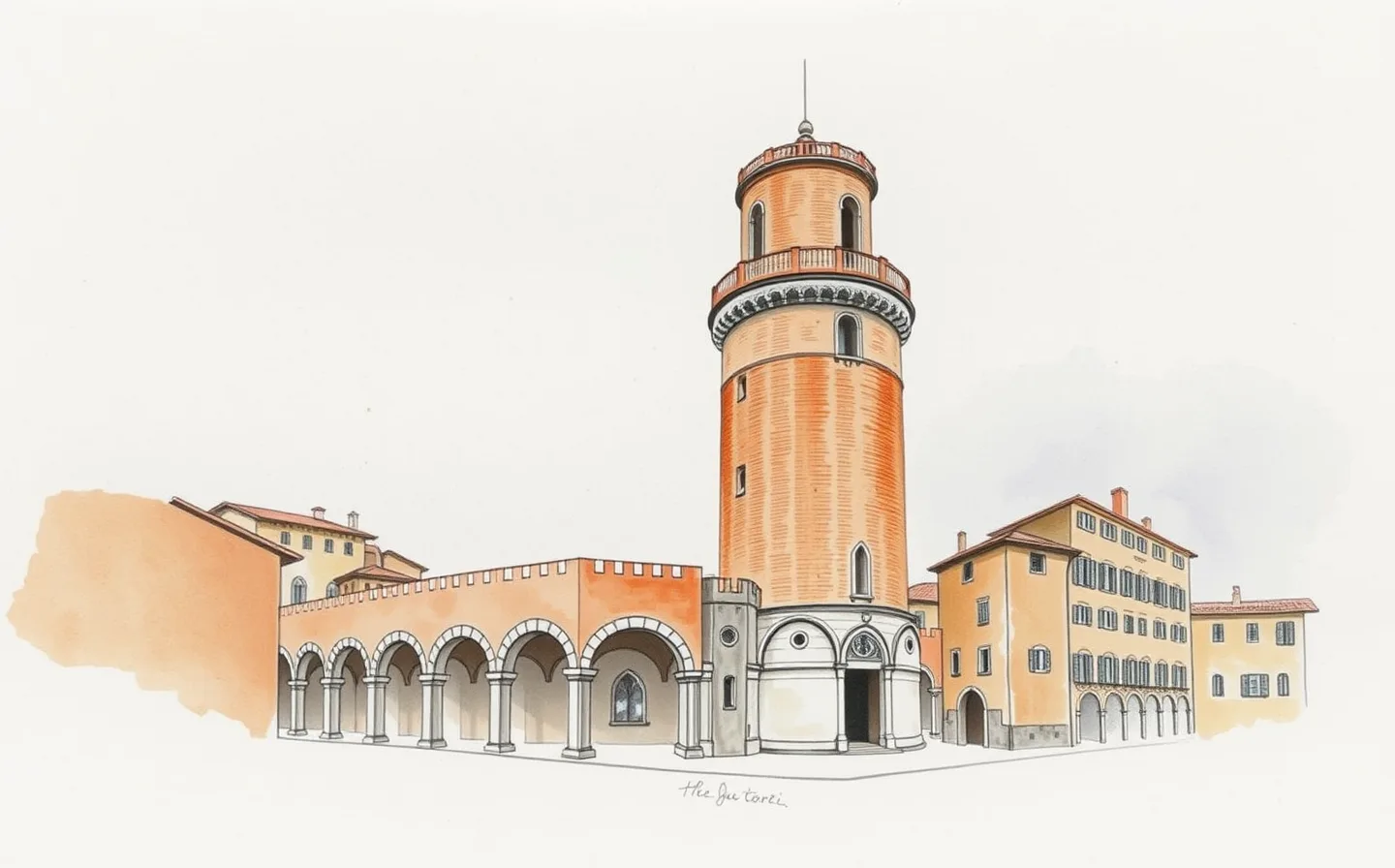
The Due Torri: one straight, one leaning, where the arcades converge
Bologna, Emilia-Romagna, Italy, Italy
Bologna is the city Italy quietly runs on. Its trains fan out to Milan, Florence, Venice and Rome within a couple of hours, yet the place has never needed to perform for visitors the way its neighbours do. The historic centre is built from brick the colour of a low autumn sun — hence its most affectionate nickname, la rossa — and threaded overhead by nearly forty kilometres of covered arcades, so continuous you can cross the old town in a downpour without opening an umbrella. Add Europe's oldest university, founded in 1088, and a kitchen that gave the world ragù, tortellini and mortadella, and you have a city built for staying, not passing through.
The Etruscans called it Felsina; Rome renamed it Bononia and laid the Via Aemilia straight through its centre, the road that still gives the region its name. By the twelfth century, rival banking families were racing to build private towers as tall as apartment blocks — as many as a hundred once stood, defensive statements in stone before they became status symbols. Only a handful survive, the leaning Garisenda and the 97-metre Asinelli chief among them. The university that followed, drawing Dante, Petrarch and Copernicus, made Bologna a magnet for scholars long before it became one for tourists. In the twentieth century the city earned a second meaning for la rossa, this one political, as a centre of anti-fascist resistance and, later, of Italy's postwar left.
Walking is how Bologna actually works. The porticoes were mandated by law as early as 1289, built so a growing student population had shelter and landlords had room to expand, and they turn the entire centre into one unbroken circuit — climb the Asinelli tower's 498 steps, or simply follow the arcades three kilometres out to the hilltop Sanctuary of San Luca. Piazza Maggiore anchors it all, Neptune presiding over his fountain since 1566, students and pensioners sharing the same benches. Nothing here is arranged for a coach tour; you find it by wandering, which is rather the point.
Do not miss — Bologna, Emilia-Romagna, Italy
Every place below is a ten-to-fifteen minute walk from the last.