Basilica of San Vitale
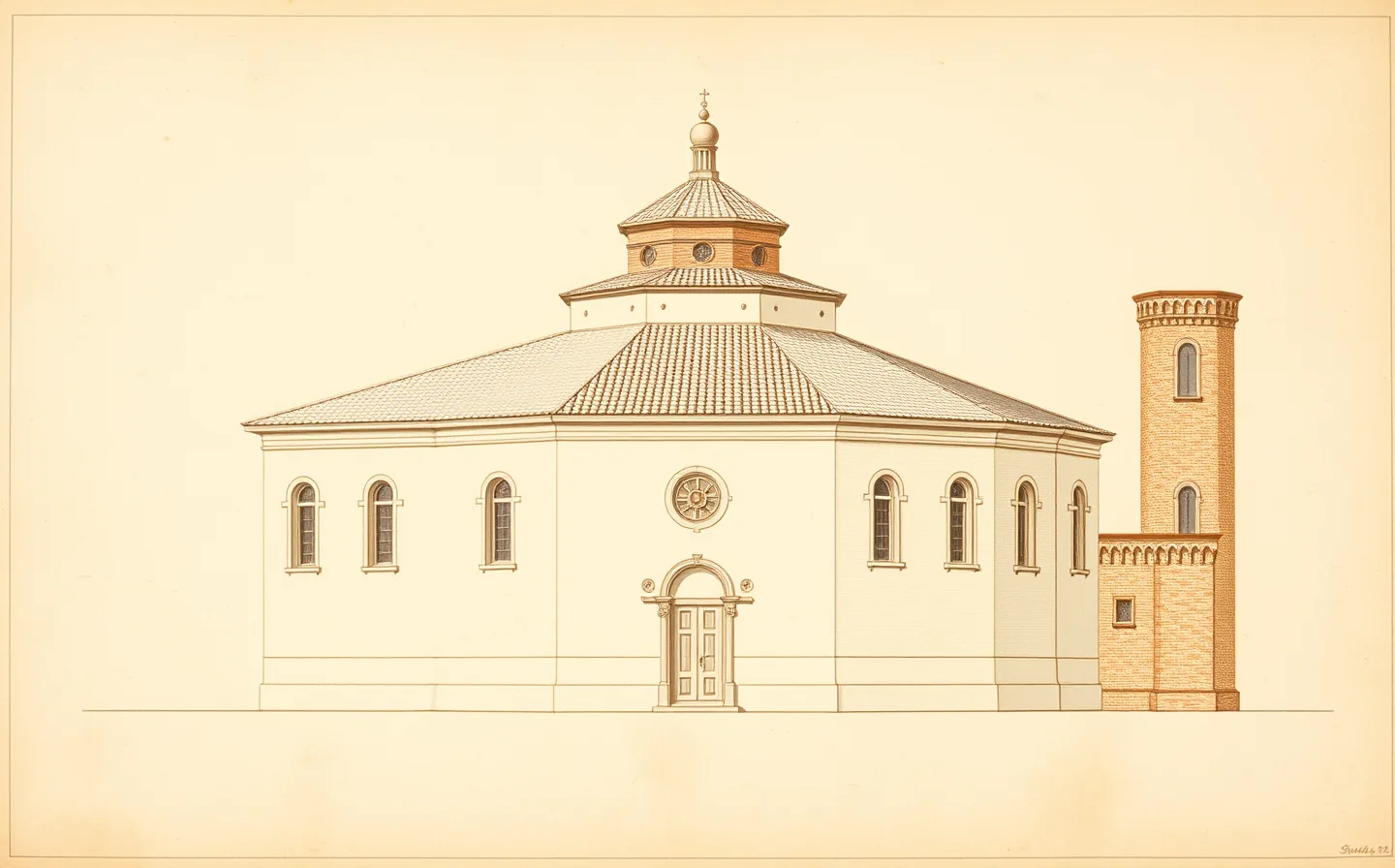
From the street this looks like a plain brick octagon, almost defensive. Step inside and the walls turn to gold. Look at the man in purple straight ahead: golden halo, jeweled crown, flanked by soldiers carrying a shield stamped with Christ's monogram. That is Emperor Justinian, ruler of Byzantium from a palace over a thousand miles away. He never once walked through this door.
Ravenna in the 540s was the western capital of an empire run from Constantinople, seized back from the Ostrogoths only a few years earlier. Justinian needed the city to know who was in charge, so he sent his portrait instead of himself: propaganda made of gold glass.
Work started in 526 under Bishop Ecclesius, bankrolled by a local financier, Julianus Argentarius, who put up 26,000 gold coins of his own money. The church finished and was consecrated in 547 by Archbishop Maximian, the bearded cleric at Justinian's shoulder, the only figure in the whole scene identified by name.
Across the apse, Empress Theodora holds her own court, her robe hemmed with the Three Magi bringing gifts, a private joke, since she is about to make an offering of her own. She never came here either.
The dome above it all is a trick: hollow terracotta tubes, nested like drinking straws, built strong without being heavy, one of the earliest recorded uses of that technique anywhere. Centuries later, Charlemagne copied this design for his own chapel in Aachen. Two rulers who never set foot in this room still run it, long after their empire lost Italy for good. That is what real power looks like. It never has to show up.
Look up at the apse ahead of you for a moment before reading anything else. A man in imperial purple stands at the center of a golden crowd, haloed, crowned, utterly still. That is Emperor Justinian. He ruled the Byzantine Empire from Constantinople, over a thousand miles from where you are standing, and he never once set foot in this room. Ask yourself why a man commissions a life-sized portrait of himself in a city he will never visit. The answer is the whole story of this building.
In the 520s, Ravenna belonged to the Ostrogoths, Germanic kings ruling Italy in the name of a vanished Roman order. Bishop Ecclesius broke ground on this church in 526, under their rule, financed by a local banker named Julianus Argentarius, who put up 26,000 gold solidi of his own money, an enormous private fortune spent on stone and glass.
Then, in 540, the political ground shifted entirely. Justinian's general Belisarius captured Ravenna for Byzantium, ending Gothic rule and reattaching Italy, however briefly, to an empire run from the Bosphorus. The church was still unfinished. When it was consecrated in 547 by Archbishop Maximian, it became something its original patrons never intended: a stage set for the new regime. Justinian never travelled here, so his mosaic did the traveling instead, an assertion of authority in a medium that does not fade.
Look at the architecture itself. San Vitale is built as a double-shelled octagon, an ambulatory wrapped around a tall central drum, a design borrowed from Constantinople rather than Rome, echoing the church of Saints Sergius and Bacchus near the imperial palace. The dome capping it all solves a very practical problem: how do you roof a wide space without unbearable weight? The answer here is hollow terracotta tubes, fitted into one another like nested cups, among the earliest recorded uses of that technique anywhere in architecture. Two and a half centuries on, Charlemagne's architect Odo of Metz modeled the Palatine Chapel at Aachen directly on this floor plan, carrying Ravenna's Byzantine ambitions into the heart of the Carolingian empire.
Now look at the mosaics themselves. Justinian's face has real, individual features, not a generic imperial type, flanked by soldiers carrying a shield marked with Christ's monogram. Beside him stands Archbishop Maximian, identified by his own name spelled out in the tesserae above his head, the single inscribed figure in the entire composition. Scholars have long noticed that his face sits slightly awkwardly among the clergy around him, as though it were fitted into a scene already designed for someone else, perhaps updated once Maximian secured his position from Constantinople. Nobody can prove it. It remains one of the small unresolved puzzles of this room.
Across the apse, Empress Theodora holds her own procession, the hem of her purple robe embroidered with the three Magi bringing gifts to Christ, a detail that turns her own approaching gift into a quiet echo of the nativity. She too never crossed the Adriatic to see herself immortalized here. The marble under your feet and around these piers was never local either: it was quarried near the Sea of Marmara, close to Constantinople, and shipped the length of the Mediterranean specifically for this building, proof of how tightly bound this provincial city was to a capital its rulers had never visited and would, within a generation, lose again.
Stand here long enough and the strangeness of it settles in. Two of the most powerful people of the sixth century exist in this room only as light and colored glass, ruling a city neither one of them ever walked through, in a building that has outlasted, by many centuries, the empire that built it.